Flo: A Sitcom Spinoff Disaster

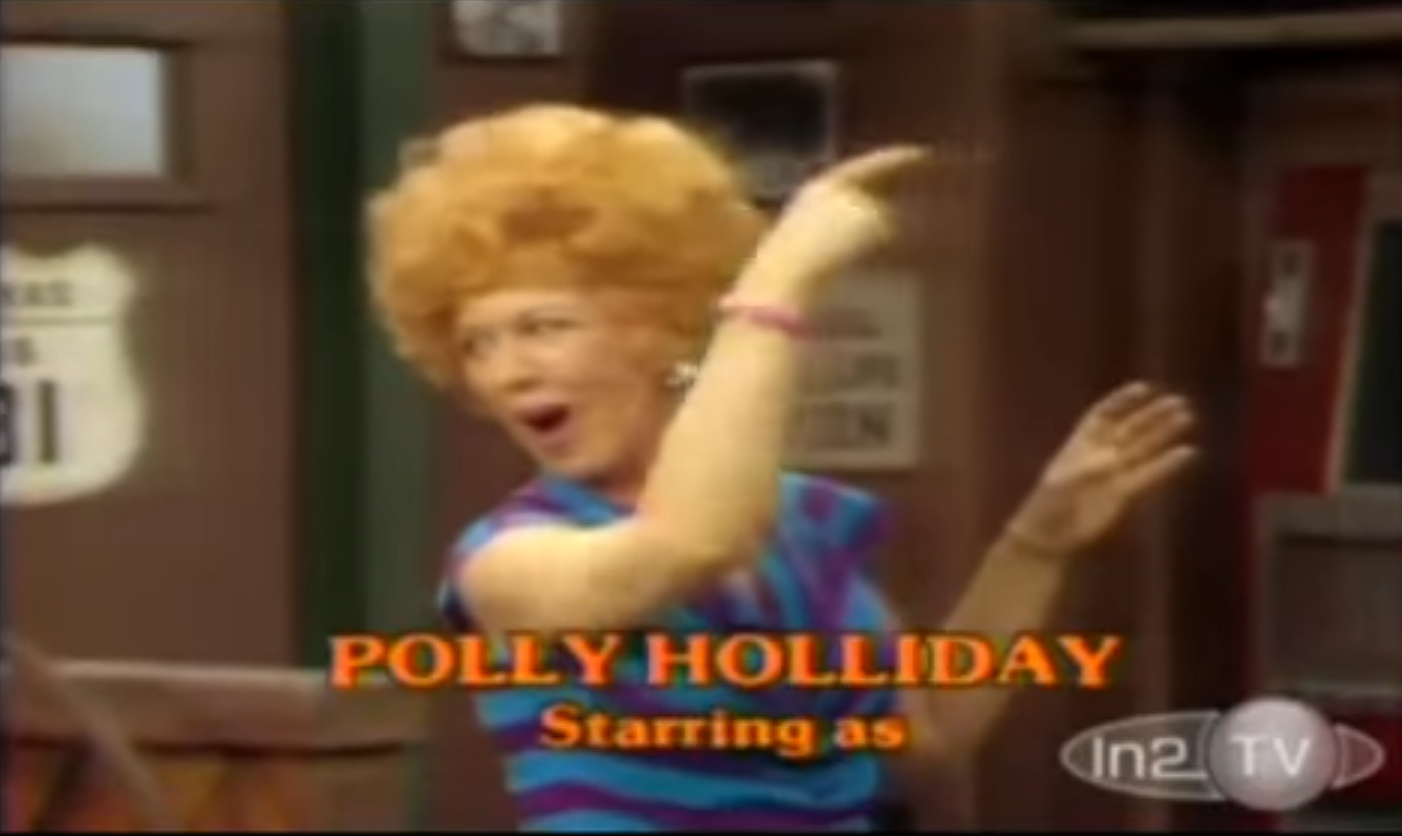
The popular CBS sitcom Alice, which ran from 1976 to 1985, was loosely based on the successful 1974 film Alice Doesn’t Live Here Anymore. The plot had recently widowed Alice Hyatt (played by Linda Lavin) taking a waitress job in Mel’s Diner, a Phoenix eatery, to make ends meet. One of her waitress colleagues was feisty Florence (Flo) Castleberry played by Polly Holliday. The character became so popular that CBS launched a sitcom focusing on Flo. The premise of the spinoff was that Flo had moved back home to Cowtown, Texas to assume the management of a rundown roadhouse which she re-christened Flo’s Yellow Rose. As a mid-season replacement, Flo aired on Monday nights in March and April 1980 and got as high as number seven in the Neilsen ratings. However, when Flo returned in the fall of 1980 its time slot was moved several times. Ratings tanked and it was gone after a total of 29 episodes. The Flo character never returned to Alice (with the exception of old clips in the series finale). Here is the opening montage of Flo.

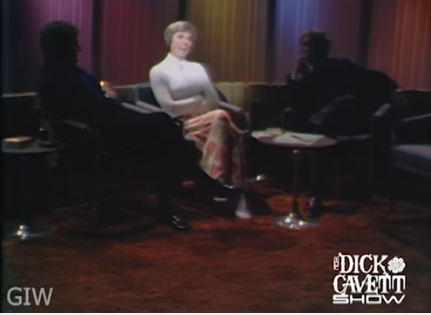
Julie Andrews on Dick Cavett Show

Here’s a gem: From a 1971 episode of The Dick Cavett Show, Julie Andrews is persuaded to sing Wouldn’t It Be Loverly? from My Fair Lady.

In 1963, Andrews began her work in the title role of Disney’s musical film Mary Poppins. She was hand picked by Walt Disney, who liked her performance as Queen Guinevere in the musical Camelot, she initially declined because she was pregnant, but Disney insisted saying “We’ll wait for you.”

Andrews next appeared in two of Hollywood’s most expensive flops: Star! (1968), a biopic of Gertrude Lawrence; and Darling Lili (1970), which is quite amusing as it is in this time that she appears in the clip above.

Unfortunately, in 1997 she developed a hoarseness in her voice, which resulted in surgery to reportedly remove non-cancerous nodules from her throat. In 1999, she filed a malpractice suit against the doctors who had operated on her throat. Originally, the doctors assured Andrews that she should regain her voice within six weeks, but Andrews’ stepdaughter Jennifer Edwards said “it’s been two years, and it [her singing voice] still hasn’t returned.” The lawsuit was settled in September 2000 for an undisclosed amount.

In recent years her career seems to have had quite a bit of a revival, taking on many modern roles in film series such as The Princess Diaries, Shrek, and Despicable Me.

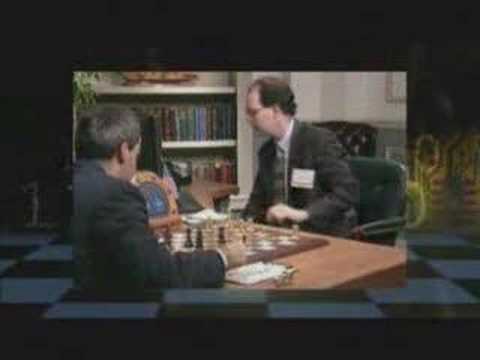
Deep Blue v Kasparov

May 11, 1997 saw one of the most important milestones in human history occur. Strangely, it was attained at the expense of humans. On that date in New York City, Garry Kasparov, the reigning world chess champion and one of the greatest players of all time, lost the deciding game of a six-game series to an IBM computer nicknamed Deep Blue. Kasparov resigned after only 19 moves, giving Deep Blue the match with a record of two wins, one loss, and three draws. The previous year, Kasparov had beaten an inferior version of Deep Blue four games to two in a series played in Philadelphia. To those in the computer industry, the triumph of Deep Blue was a cause for celebration. To many chess followers and ordinary folks, however, the result was ominous: Artificial intelligence had surpassed one of the great minds in human history. Here is a six-minute video about the 1997 event.

After losing, Kasparov said that he sometimes saw deep intelligence and creativity in the machine’s moves, implying that during the second game, human chess players did some of the moves of the machine, which would be a violation of the rules. IBM denied cheating, saying the only human intervention occurred between games. The rules allowed the developers to modify the program between games, an opportunity they said they used to shore up weaknesses in the strategy of the computer which was revealed during the match. Kasparov requested printouts of the machine’s log files, however IBM refused. Later, IBM published the logs on the Internet.

Search For Tomorrow

How many of you remember soap operas with organ music played throughout the episode to set the mood? The organ was used in soap operas all the way to the 70’s and it took a musician strike for them to actually stop using the organ!

Search for Tomorrow was a soap opera that ran on CBS from 1951 through 1968 as a fifteen-minute show sponsored by Proctor and Gamble. In 1968 the show went to thirty minutes. It was then picked up NBC in 1982 until it’s final episode in 1986. The show was actually performed live from the start until 1967 in favor of recorded telecasts. If you look at this clip from 1962 you can see it looks like theatrical stage acting as opposed to TV acting. Its fun watching the old dial-up telephone in use

The show was set in a town called Henderson but they never revealed the state. The main characters Mary Stuart and Larry Haines. At the time it was the longest-running soap opera at 35 years and was canceled due to low ratings.

At one point you were able to watch reruns during the late 80’s on USA Network and then on America Online video service in 2006. Who knew AOL had a video service?

I remember watching this with my grandmother in the 80’s. I use to watch General Hospital but preferred to share time with grandmother. We would get our lunch after I cleaned her house and sit and watch her soaps. Such sweet memories and a way to connect with her!

Oh, and what about the commercial for Dash? I was able to find it available for purchase only from an Italian website: https://piccolosgastronomia.com/products/dash-polvere-actilift-powder-1-625kg-box?variant=31401458925671&currency=USD

https://www.theretrosite.com/wp-content/uploads/2020/05/As-The-World-Turns.mp4
Organ music was still used in this 1962 soap opera.

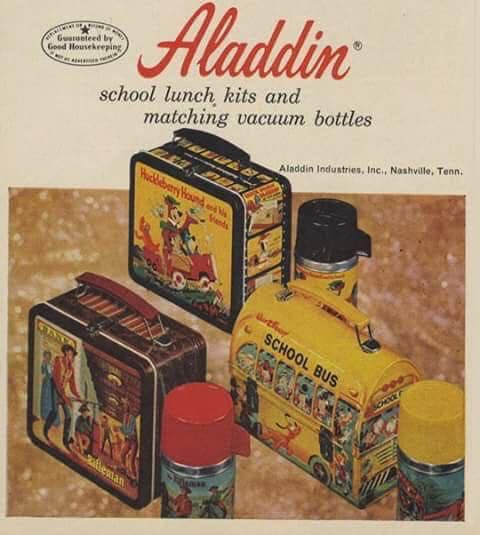
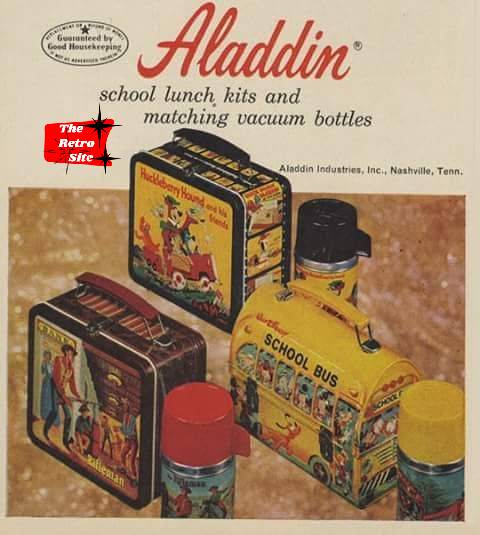
Aladdin School Lunch Boxes

Aladdin Industries was founded in 1908 as a kerosene lamp and stove company as Mantle Lamp Company (now you know why it’s called Aladdin as in Aladdin’s Lamp). In 1914 it diverse to manufacture vacuum bottles and thermal jars. In the 1950’s the company began producing lunch boxes. Their first licensed character was Hopalong Cassidy. Sales went from 50,000 units to 600,000. As a result TV branding was their focus and they dominated the lunchbox market. By 1965 the Aladdin acquired Stanley Bottle which helped them dominate the market.

I always envied the kids at school who had the school bus lunch box. Having four other brothers brown paper bagged lunches would have to do. Which one was your favorite?

Today, metal lunch boxes are not permitted in many schools in fear that they could be used as a weapon. How times have changed.

Exit mobile version