



Looking at this old Montgomery Ward catalog page, I’m struck by how much detail went into a baby doll’s carriage. Folding hoods, big wheels, curved metal frames and colorful bodies—these were little versions of the carriages adults pushed around town. Wards even called them “Authentic English-Style Prams,” making a toy sound like a luxury purchase.
⠀
But those prices weren’t quite the bargains they appear to be! Using 1955 as a comparison year, the featured $12.99 red-and-white carriage equals roughly $162 in today’s dollars. The $16.88 Deluxe Coach would be about $211. The $7.99 Good Coach comes to around $100, the $9.79 Better Coach about $122, and the $4.98 Economy Coach roughly $62. The catalog’s exact year isn’t confirmed, so these are approximate inflation comparisons.
⠀
That puts things in perspective. A fancy doll carriage could be a substantial birthday or Christmas gift. A child might fall in love with the deluxe model while a parent quietly checked the economy price.
⠀
The play itself was simple. Tuck the doll under a blanket, adjust the hood and head out for a walk. No screen or programmed storyline was needed. The child decided where they were going and what their baby needed.
⠀
Today’s doll strollers can look like the compact models parents use now. The styles have changed, but children still enjoy copying grown-ups and caring for their dolls.
⠀
Shopping has changed even more. We can compare stores and read reviews in minutes now. Back then, a catalog page could hold our attention for weeks. We studied the pictures, circled favorites and hoped someone would take the hint. I think that anticipation was part of the fun.
⠀
Did you have a doll carriage like one of these—or remember leaving a catalog open to the toy you wanted?
Category: 1950’s


Happy Birthday to the United States Air Force!

On September 18, 1947, the U.S. Air Force officially became an independent branch of the military. So today marks its 79th birthday.
I thought this early-1950s recruiting commercial was a great way to look back at just how young the Air Force still was at the time.
The cartoon wasn’t simply advertising enlistment. It was recruiting young men for the Aviation Cadet program, where successful candidates could become pilots or other flying officers.
And check out the sales pitch: jets, travel, officer’s wings — and more than $5,000 a year after graduation.
There was a reason the Air Force was advertising so aggressively. Historical records show it was dealing with a serious shortage of Aviation Cadet applicants in the early 1950s. Requirements were adjusted, the minimum age was lowered to 19, and recruiting teams were sent onto college campuses looking for candidates.
It’s also easy to forget just how new everything was. The Air Force hadn’t even celebrated its tenth birthday yet, and the Air Force Academy didn’t exist when this recruiting push began. Congress wouldn’t authorize the Academy until 1954.
And since we’ve been paying more attention to the music in these old commercials, I looked into that too. I couldn’t find a reliable credit for the jingle used in this particular ad, so I’m not going to guess.
But here’s something I never knew about the official Air Force Song.
Robert Crawford wrote what became “Off We Go Into the Wild Blue Yonder” in 1939 — and according to Air Force history, he first came up with the melody while flying from Bridgeport, Connecticut, to Trenton, New Jersey.
Even better, the first page of Crawford’s original handwritten score eventually went much farther than Bridgeport or Trenton — Apollo 15 carried it to the surface of the Moon in 1971.
From a brand-new independent service in 1947 to the Moon barely 24 years later.

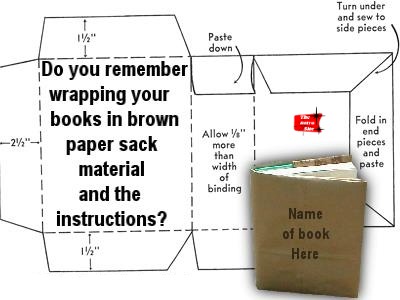
SHOW THE GRANDKIDS HOW IT WAS DONE!
Before stretchy fabric book covers and plastic sleeves, we had the brown paper grocery bag!
Every September, out came the scissors, tape, and a stack of supermarket bags. You cut the bag open, folded the top and bottom to fit the textbook, tucked the covers into the ends, and somehow ended up with a perfectly serviceable book cover.
And the best part? That plain brown paper became your personal bulletin board — your name, doodles, band names, phone numbers, crushes, class schedules and whatever else you could squeeze onto it.
It protected the school’s textbook, cost absolutely nothing, and gave us something to do during a boring class.
Who remembers covering all their schoolbooks this way? And did yours stay neat — or was it covered in writing by the end of the first week?

MIGHTY MOUSE & ZESTABS — WHEN CARTOON HEROES SOLD VITAMINS
Seeing Mighty Mouse selling vitamins takes me right back to an era when our Saturday-morning cartoon heroes seemed capable of selling just about anything. In this commercial, Mighty Mouse gets clobbered by a cat, takes a Zestabs chewable vitamin and suddenly turns the tables — not exactly subtle advertising, but certainly memorable!
There’s actually much more history behind this little commercial than I expected. Zestabs came from Sauter Laboratories, a division of pharmaceutical giant Hoffmann-La Roche. That strange “Mighty Mouse — Nutley, New Jersey” slate at the end makes sense once you learn that Roche’s longtime American headquarters and research complex was in Nutley.
The campaign also arrived just as people were beginning to question how products were marketed to children. Zestabs came in fruit flavors and later chocolate, and groups such as Action for Children’s Television objected to advertisements that made vitamin pills look and taste too much like candy. By 1972, Hoffmann-La Roche said it had stopped placing its vitamin commercials inside children’s programs, although Zestabs advertising continued elsewhere on television.
And here’s one connection I never expected: years before Pretty in Pink or Two and a Half Men, Jon Cryer says his first paying acting job at age four was a Zestabs commercial.

The Bullwinkle Show
I think one of the reasons Rocky and Bullwinkle still holds up is that when we watched it as kids, we probably weren’t getting half the jokes! The kids got a flying squirrel, a goofy moose and Boris and Natasha constantly trying to cause trouble, while the adults were getting political satire, pop-culture references and some pretty clever wordplay.
The show actually started in 1959 as Rocky and His Friends before moving to NBC in 1961 and becoming The Bullwinkle Show. What surprised me was how much talent was packed into those voices. Bill Scott, who played Bullwinkle, was also the show’s head writer and co-producer. June Foray voiced both Rocky and Natasha, Paul Frees played Boris, and that great narrator’s voice belonged to William Conrad, who many of us later knew as Cannon.
Here’s another one I didn’t know: Bullwinkle’s name reportedly came from a real person, Clarence Bullwinkel, who owned a car dealership near Berkeley and was known by creator Alex Anderson.
And despite how simple the animation sometimes looked, that almost became part of the charm. A lot of the animation work was done in Mexico to keep production costs down, while the writing remained incredibly sharp.
I went back to these cartoons expecting pure childhood nostalgia, but they’re actually funnier when you’re old enough to understand what the writers were sneaking past us!

The Real McCoys
As kids, we used to make fun of the way Walter Brennan walked. Now I sort of walk like him!
Seeing this Real McCoys opening brought back one memory, but then I noticed where the clip came from and got another one — TNN, The Nashville Network. So this turned into a double reminisce for me: remembering a television show from my childhood through a cable network that itself has now disappeared under that name
The Real McCoys premiered in 1957 with Walter Brennan as Grandpa Amos McCoy, heading up a West Virginia family that relocates to a farm in California. Richard Crenna played grandson Luke, Kathleen Nolan was Luke’s wife Kate, Lydia Reed played Hassie, Michael Winkelman was Little Luke and Tony Martinez was farmhand Pepino. The show was filmed at Desilu and co-produced by Danny Thomas.
And about that walk we used to imitate — apparently Walter Brennan was acting it. A Los Angeles Times account notes that Brennan didn’t actually have the limp himself, although he used that distinctive gait for several of his characters. All these years later, I find out the walk we were copying wasn’t even really his!
Brennan was already a major movie star by then and had become the first actor to win three Academy Awards for acting. Richard Crenna had been the squeaky-voiced Walter Denton on Our Miss Brooks before becoming Luke McCoy, and years later many of us would know him as Colonel Trautman in the Rambo movies. Kathleen Nolan made some history of her own in 1975 when she became the first woman elected president of the Screen Actors Guild.
The show was no minor success either. It reached number eight in the Nielsen ratings during 1958–59 and climbed all the way to number five during 1960–61. After five seasons on ABC, it moved to CBS for one final season before ending in 1963.
Then there’s the second memory in this clip. TNN acquired The Real McCoys in 1999 and aired two episodes every weekday afternoon, actually giving the series its first cable-TV run more than three decades after it ended. TNN itself had started as The Nashville Network, became The National Network, disappeared as a name when it became Spike TV in 2003, and that channel eventually became Paramount Network.
So I started out remembering Grandpa Amos and somehow wound up reminiscing about TNN too
Do you remember The Real McCoys — and how many of you also remember watching those old shows on TNN?

Alfred Hitchcock Presents
“Good evening.” With those two words, Alfred Hitchcock welcomed viewers into a weekly world of murder, mystery, suspense and wonderfully dark humor.
Alfred Hitchcock Presents premiered on CBS in 1955 and ran for seven seasons as a half-hour anthology. In 1962, it expanded into The Alfred Hitchcock Hour, continuing for three more seasons until 1965. Each episode told a separate story, usually ending with an unexpected twist or a criminal discovering that the perfect crime was not quite perfect.
The opening became almost as famous as the stories. Hitchcock stepped into a simple outline of his unmistakable profile while Charles Gounod’s “Funeral March of a Marionette” played. Hitchcock had drawn the nine-stroke caricature himself.
Although he introduced every program, Hitchcock directed only 17 episodes of the original half-hour series. Producers Joan Harrison and Norman Lloyd helped select stories, writers, directors and actors who could deliver a complete suspense film in less than 30 minutes.
The television series also influenced Hitchcock’s movies. He later used members of the show’s experienced television crew to make Psycho, helping him film quickly and economically while creating one of the most famous thrillers ever made.
Did the theme music make you uneasy before Hitchcock even said, “Good evening”?

It Was More Fun the Colorforms Way
As requested by a number of viewers, here is the Raggedy Ann Colorforms commercial I remember from childhood. I have since discovered just how many different Colorforms kits were made, and I will share more of them over time.
Colorforms used colorful pieces of reusable vinyl that clung to smooth surfaces without glue. Children could dress the characters, rearrange the scenes, peel everything off and begin again. The Raggedy Ann kit shown in this 1967 commercial allowed kids to change her dresses and accessories as often as their imaginations allowed.
Colorforms began in 1951 after Harry and Patricia Kislevitz experimented with colorful vinyl originally used to make handbags. They discovered that the pieces clung to the glossy walls of their bathroom and began cutting them into different shapes. What started as a creative experiment soon became a successful toy.
FAO Schwarz placed an early order for 1,000 sets, helping turn the small project into a real company. The first kits featured basic geometric shapes, but licensed characters soon followed. Popeye became the first in 1957, opening the door for hundreds of television, comic book and movie characters.
Even the familiar Colorforms logo has an interesting history. Legendary graphic designer Paul Rand, who also designed logos for IBM, ABC and UPS, created it in 1959.
I also remember watching the local weather forecast as a child. The station used happy, smiling suns, large red H’s for high pressure and other colorful symbols that looked like oversized Colorforms.
Before computer-generated weather graphics, forecasters physically moved reusable symbols around a large map. Depending on the station, those symbols could be made from magnetic rubber, felt or another cling-on material. Whatever they were made from, they looked remarkably similar to the Colorforms we played with at home.
Maybe that is why those old weather maps remain so memorable. The smiling suns, rain clouds and giant H’s and L’s made the forecast feel like a giant Colorforms set coming to life on television.
Do you remember your local weather forecaster moving those colorful symbols around the map?

Winston Tastes Good Like A …….
This animated commercial proves you did not need actors, scenery or even much animation to create something memorable. Musical notes dance across the screen, letters form the Winston name, and the package appears while the singers deliver one of advertising’s most familiar jingles.
The clip matches a 1963 Winston television spot, although the campaign began with the brand’s introduction in 1954. R.J. Reynolds named Winston after Winston-Salem, North Carolina, and promoted it as a filtered cigarette that still delivered flavor. The brand became the country’s best-selling cigarette by 1966.
The William Esty advertising agency built the campaign around “Winston tastes good like a cigarette should.” The use of “like” instead of “as” was intentional, creating a national grammar argument that helped make the slogan even more memorable. Walter Cronkite refused to say it incorrectly, Merriam-Webster cited it during a language debate, and Winston eventually answered its critics by asking whether they wanted good grammar or good taste.
Margaret Johnson ghostwrote the jingle and recorded it with her husband, Travis Johnson, and their group, the Song Spinners. The melody’s two quick handclaps became almost as recognizable as the words themselves. Winston later carried the campaign into popular television programs, including The Flintstones, where Fred, Barney and other Bedrock characters promoted the cigarettes.
Seen today, the commercial is also a reminder of how common cigarette advertising once was on television. Growing evidence about smoking’s health risks eventually led to the removal of cigarette commercials from American radio and television beginning in 1971.
Do you remember the words first, or those two perfectly timed handclaps?

I Want My Maypo!
This wonderfully simple 1956 commercial begins with Marky refusing to eat his breakfast while wearing his cowboy hat. Uncle Ralph tries the old airplane-and-hangar trick, accidentally puts the spoon into his own mouth and discovers that he likes Maypo. When Uncle Ralph begins eating the entire bowl, Marky finally delivers the line remembered by generations: “I want my Maypo!”
Animation pioneer John Hubley created the commercial around recordings of his four-year-old son, Mark. Rather than giving the boy a polished script, Hubley followed him with a microphone and built the cartoon around his natural words, reactions and mispronunciations. The result felt more like a funny family moment than a commercial.
The campaign transformed a poorly selling maple-flavored oatmeal into a national favorite. Sales rose an average of 78 percent and climbed as high as 186 percent in some markets. Marky became so popular that he appeared on packaging and inspired a vinyl bank, although Hubley initially fought attempts to merchandise a character based upon his own child.
Later commercials featured major athletes including Mickey Mantle, Wilt Chamberlain, Johnny Unitas, Don Meredith and Oscar Robertson declaring that they wanted their Maypo. Marky received a modern makeover in 2001, but kept his familiar cowboy hat and kerchief.
Maypo remains available today, proving that Marky’s demand lasted much longer than anyone probably expected.
Did you eat Maypo, or did you simply run around the house shouting, “I want my Maypo!”