Have You Retired And Return Back To Work?

Have you ever found yourself stepping back into the workforce after retirement? You’re not alone. In Florida, a growing number of retirees are returning to work in 2025, driven by financial pressures and a desire for engagement.

Rising Costs Prompt Return to Work

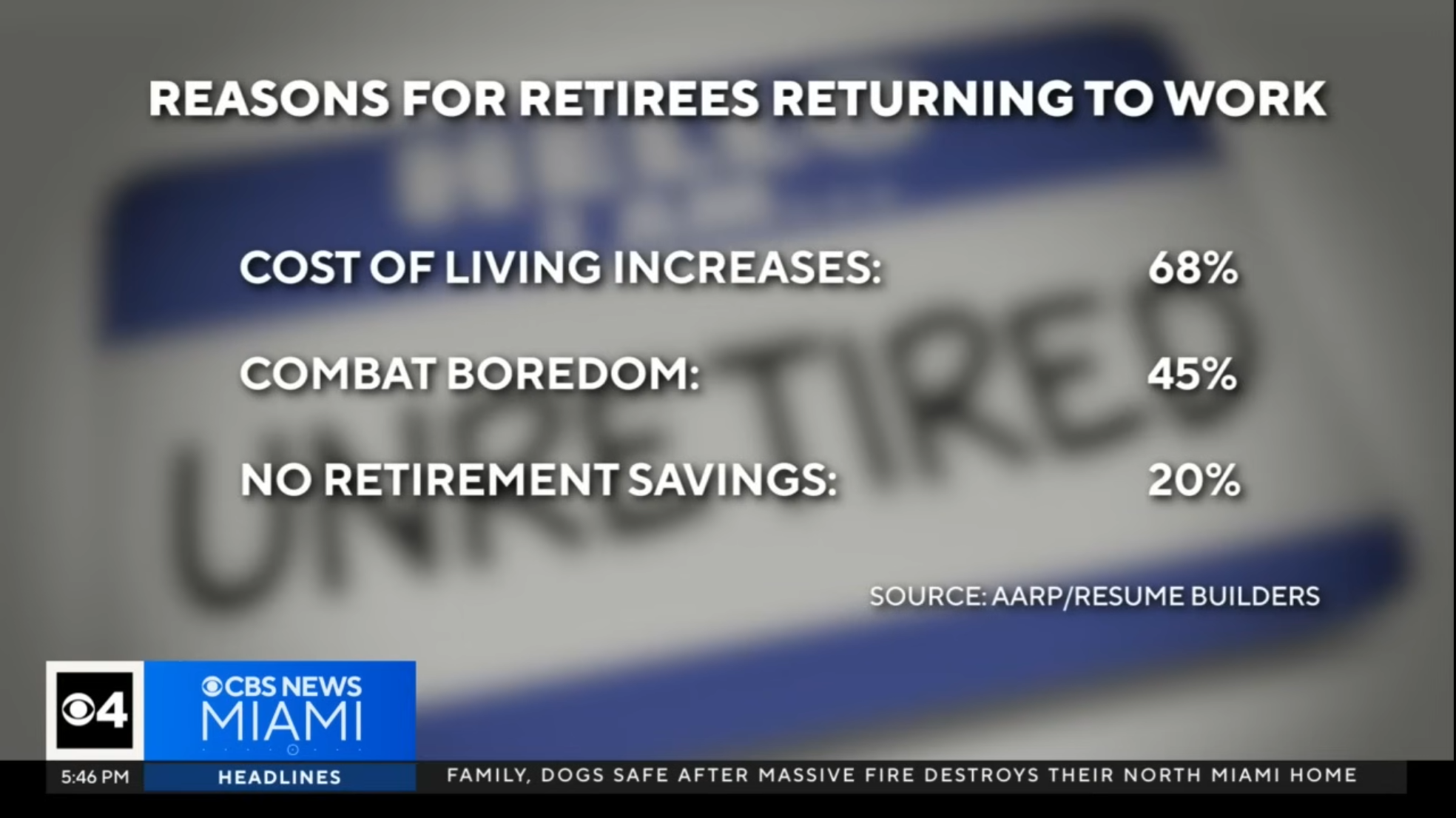
A Resume Builder survey indicates that 13% of retirees aged 65 to 85 plan to reenter the workforce this year. Among them, 51% cite the escalating cost of living as the primary reason, while 37% report having no retirement savings. MoneywiseCBS News

Take the case of Janette Campbell, a retired teacher from Miami. Facing challenges in affording her mortgage and groceries, and supporting an ill husband and a grandson with autism, she felt compelled to seek employment again. CBS News+1Moneywise+1

Financial Strains on Fixed Incomes

Many seniors rely solely on Social Security, which has seen a decline in purchasing power. Maritza Lopez of AARP’s Community Service Employment Program notes that some retirees receive as little as $500 to $1,000 monthly, insufficient to cover rising expenses. CBS News+3Tampa Bay Times+3The Motley Fool+3CBS News

The Motley Fool reports that 62% of retirees have reduced nonessential spending due to inflation, with 44% struggling to afford groceries and 40% facing difficulties with utility bills. The Motley Fool


Housing Costs Add to the Burden

Florida’s housing market has seen significant increases. The median home sale price reached $411,100 in December 2024, up from approximately $250,000 five years prior. Condo association fees in Miami-Dade County have also surged, with median monthly fees rising to $900, a 59% increase since 2019. CBS News+1Moneywise+1Moneywise

Seeking Purpose Beyond Finances

Not all retirees return to work solely for financial reasons. Philip Williams, a former grants administrator, now works part-time at a charter school in Miami Springs. While he doesn’t need the income, the role keeps him engaged and supports his passion for playwriting. CBS News+1Moneywise+1Moneywise+1CBS News+1

This trend, sometimes referred to as the “Quiet Return,” highlights a shift where retirees seek both financial stability and meaningful engagement. As Julia Dattolo of CareerSource Palm Beach observes, seniors return to work due to economic necessity, the desire for social interaction, and personal interest. Broward CountyMoneywise+1Broward County+1

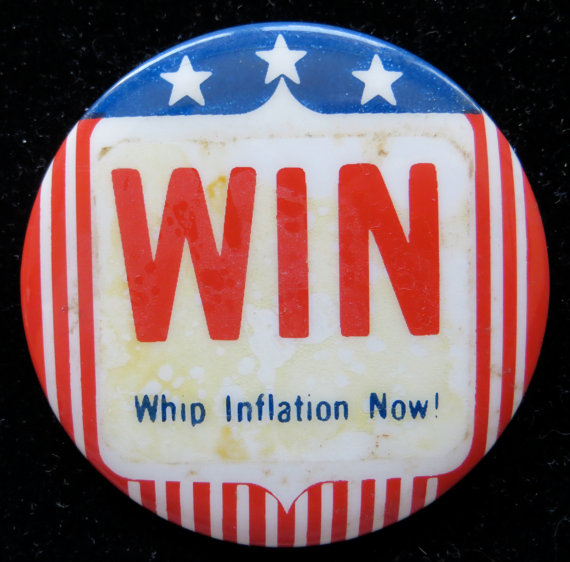
In The 70’s, This Is How We Whipped Inflation…

“WIN buttons” from the 1970s refer to a campaign launched by U.S. President Gerald Ford in 1974 called “Whip Inflation Now” (WIN). The campaign was part of Ford’s effort to combat the high inflation that plagued the U.S. economy during the mid-1970s.

Background

  • After the 1973 oil crisis and years of government spending on the Vietnam War and social programs, the U.S. faced rampant inflation.
  • President Ford addressed Congress on October 8, 1974, proposing a range of voluntary measures for Americans to curb inflation, such as conserving energy and reducing spending.

The WIN Campaign

  • WIN buttons were handed out as a form of patriotic encouragement. Americans were urged to wear them to show their commitment to fighting inflation.
  • The idea was that grassroots efforts—like saving money, avoiding waste, and boosting productivity—would help stabilize prices.

Public Reaction

  • The campaign was widely mocked and is often remembered as a failed public relations stunt.
  • Critics said the campaign lacked substance and placed too much responsibility on individuals rather than addressing deeper economic policies.
  • Some even wore the WIN buttons upside down, so they read “NIM”—interpreted as “Need Immediate Money.”

Legacy

  • Despite its failure, the WIN campaign is a memorable example of 1970s-era economic policy and presidential messaging.
  • It’s often cited in history and economics classes as a case study in how not to handle economic crises with symbolism over substance.

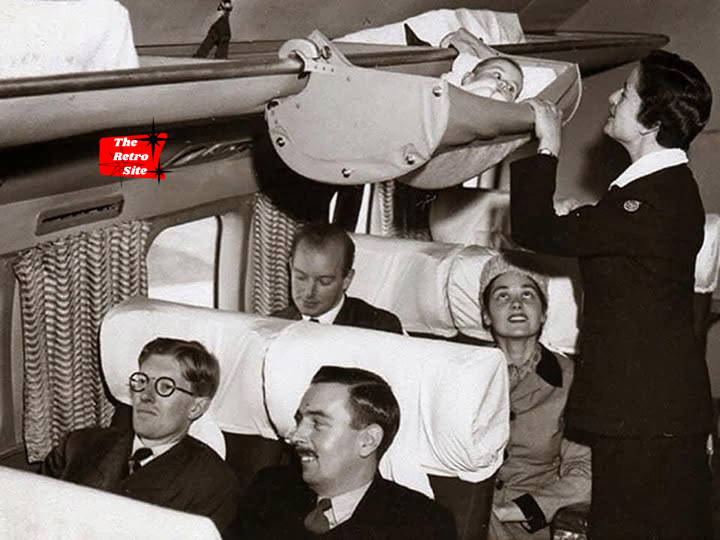
Nothing Says ‘Baby Safety’ Like a Canvas Hammock Over Your Head at 30,000 Feet

This vintage photo shows a fascinating glimpse into air travel from the 1950s. What you’re looking at is an old airplane cabin featuring an unusual amenity: a baby bassinet suspended above the seats, mounted to the overhead luggage rack.

These airborne bassinets were part of early commercial airliners’ efforts to accommodate families traveling with infants. The baby appears to be safely tucked into a canvas-style cradle, and a flight attendant is checking on the child while passengers below watch or relax.

This setup would never meet today’s safety standards, but at the time, it was seen as a convenient way to let parents rest while the baby was secured overhead.

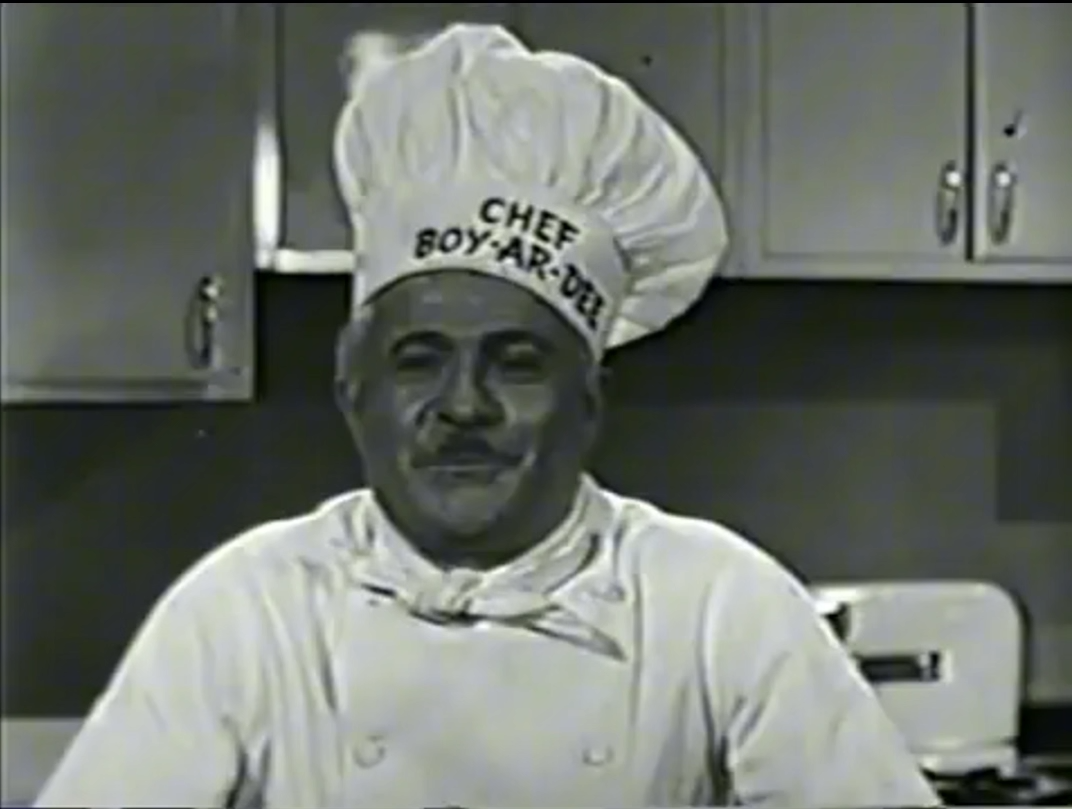
Chef Boyardee Was A Real Person

While many recognize the smiling chef on the label of Chef Boyardee cans, few realize he was a real person: Ettore Boiardi, an Italian immigrant whose culinary legacy continues to feed millions.

Born in Piacenza, Italy in 1897, Boiardi immigrated to the United States in 1914. By his twenties, he had already made a name for himself as a talented chef, even helping cater President Woodrow Wilson’s wedding reception at The Greenbrier Hotel. Eventually settling in Cleveland, Ohio, Boiardi opened his own restaurant, Il Giardino d’Italia, in 1924.

Customers loved his food so much that they began asking for takeaway portions of his pasta and sauce. To meet demand, Boiardi and his family started bottling his recipes, using old milk bottles to package his now-famous tomato sauce. In 1928, this side project officially became Chef Boy-Ar-Dee—a phonetic spelling that helped American consumers pronounce his Italian name.

The brand quickly expanded and gained national recognition. During World War II, Boiardi’s factory pivoted to produce rations for U.S. soldiers overseas, earning him a Gold Star award from the War Department for excellence in wartime production.

Know when your packages arrive and help support our page!

Today, the Chef Boyardee label—now owned by ConAgra Brands—remains a household name. It continues to produce popular products like beef ravioli, spaghetti and meatballs, and beefaroni, all while keeping the iconic image of Boiardi on its packaging.

Far from being just a convenient canned meal, Chef Boyardee is a story of immigrant success, culinary passion, and American ingenuity—one spoonful at a time.

When Cartoons Were Just Ads in Disguise: The Era of Toy-Tie In Animation

In the 1980s and 1990s, Saturday morning cartoons weren’t just entertainment—they were part of a broader marketing strategy designed to sell toys directly to kids. These shows blended colorful characters, high-stakes storylines, and action-packed sequences with one clear goal: move merchandise.

It all started to shift in 1984, when the Federal Communications Commission (FCC) rolled back rules restricting how children’s programming could promote products. This opened the door for shows to be built entirely around toy lines, so long as they weren’t technically “commercials.” The result? A wave of cartoons whose primary purpose was to advertise action figures, vehicles, and playsets—just without calling it that.

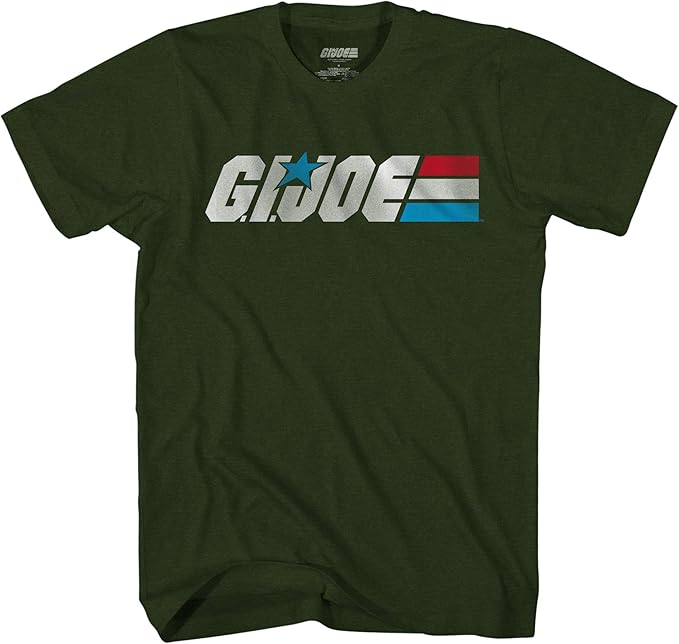
One of the early and most influential examples was G.I. Joe: A Real American Hero, which launched in 1983 as a five-part animated miniseries. Created in collaboration between Hasbro and Marvel, the series introduced new characters and gear in sync with upcoming toy releases. Each episode essentially served as a preview for the next round of toys hitting store shelves.

Teenage Mutant Ninja Turtles followed in 1987, turning a dark independent comic into a brightly-colored, kid-friendly franchise. The show’s ever-expanding cast of mutants, gadgets, and villains made it a merchandising powerhouse. In fact, toy ideas often drove the direction of the show’s plots, with new characters or weapons added simply to match what was about to hit retail.

By the 1990s, the formula was fully in motion. Street Sharks, debuting in 1994, was practically reverse-engineered from a toy line. With oversized muscles, bold colors, and gimmick features, the characters were built to stand out in toy aisles. The show followed suit, showcasing their signature powers and vehicles in ways that emphasized how fun they’d be to own.

Behind the scenes, studios were choosing shows based on toy shelf appeal, not storytelling strength. It became common for animation writers to get notes not from producers, but from toy companies. The logic was simple: if a character couldn’t be turned into a toy, why write them into the script?

But as the 2000s neared, this model faced increasing criticism. Advocacy groups and concerned parents began pushing back, arguing that these cartoons blurred the line between content and advertising in ways that exploited children’s impressionability. The FCC responded with stricter rules around advertising to kids, especially regarding shows that aired during weekend mornings or claimed to be “educational.”

Networks, under pressure, began stepping away from overt toy tie-ins. At the same time, the rise of cable TV and digital platforms gave studios more freedom to create content not strictly tied to merchandise. Slowly, the golden age of the toy-based cartoon faded, leaving behind a legacy of plastic nostalgia—and a generation that grew up watching ads they didn’t even realize were ads.

Exit mobile version