online community focused on sharing and reminiscing about video, audio, and images that stir our memories of the past – old television, theme songs, commercials, print advertisements, the sights and sounds you remember
Few advertising campaigns captured the spirit of freedom and fun quite like Kawasaki’s “Let the Good Times Roll.” Debuting in the late 1960s and taking off through the 1970s, the campaign helped redefine motorcycles—not just as machines, but as a lifestyle. Riders cruising open roads, wind in their face, and a sense that adventure was always just one throttle twist away.
But what truly made the campaign unforgettable wasn’t just the imagery—it was the music.
The now-iconic jingle was performed by The Ron Hicklin Singers, led by Ron Hicklin, with Gene Morford delivering the smooth, confident lead vocal. His delivery made the slogan feel effortless and cool—never pushy, always inviting.
And then something happens: the song sticks.
Long after the commercial ends, you find yourself replaying it in your head. That’s no accident. The jingle checks every box of what makes music memorable—simple phrasing, a strong melodic hook, bright upbeat tones, and just enough repetition to lock it into your brain. It’s what we now call an “earworm,” and Hicklin’s group practically perfected the formula.
In fact, if the Kawasaki jingle feels familiar, it’s because you’ve likely heard these voices many times before.
The Ron Hicklin Singers were behind or involved in a wide range of iconic TV themes and commercials, including shows like The Love Boat, Happy Days, and Laverne & Shirley, along with contributions to pop-driven series like The Partridge Family. They also dominated the advertising world, lending their sound to major brands like McDonald’s, Coca-Cola, and countless automotive campaigns.
Their signature style—tight harmonies, clean vocals, and instantly catchy melodies—helped define an era when TV themes and commercials were crafted with the same care as hit songs.
That’s why “Let the Good Times Roll” still resonates today. It isn’t just nostalgia—it’s a masterclass in how music, voice, and message can come together to create something timeless. You may forget the details of the commercial, but the moment you hear that line again, it clicks.
Before conversations about pay equity became part of everyday headlines, Batgirl was already taking a stand—on national television. In a memorable public service announcement from the 1970s, Batgirl, portrayed by Yvonne Craig, teamed up with Robin to deliver a powerful message: women deserve equal pay for equal work.In the short segment, Robin questions why Batgirl should earn the same as her male counterparts. Batgirl quickly shuts that down, explaining that ability—not gender—should determine pay. The message was simple, direct, and ahead of its time, especially during an era when workplace equality was still gaining traction.
What made the commercial so effective was its use of familiar pop culture heroes to address a real-world issue. By placing Batgirl in a position of authority and intelligence, the PSA reinforced that women were just as capable as men in any role—whether fighting crime or building careers.
Decades later, the message still resonates. The Batgirl equal pay commercial remains a standout example of how entertainment can be used to push social progress, proving that even superheroes can help change minds off-screen.
Before cartridges, before joysticks, before gaming became a lifestyle, there was Pong—and for millions of families, the way Pong entered the living room was through the Coleco Telstar.
Released in 1976, the Coleco Telstar was one of the earliest and most successful home video game consoles ever made. Simple, sturdy, and unmistakably 1970s in design, it helped turn video games from a novelty into a mainstream household activity.
From Leather to Living Rooms
Coleco didn’t start out in electronics. The company’s name originally stood for Connecticut Leather Company, a business that made leather goods and inflatable pools. But in the mid-1970s, Coleco spotted an opportunity. Atari’s arcade hit Pong had ignited public interest, and advances in chip technology made it possible to replicate the experience at home.
Coleco jumped in at exactly the right moment.
What the Telstar Did
The original Telstar was a dedicated console, meaning the games were built directly into the hardware—no cartridges, no downloads, no updates. You flipped a switch, turned the dials, and played.
The system featured three Pong-style games:
Tennis (classic Pong)
Hockey
Handball
All gameplay took place in black and white, displayed through an RF switch connected to a television. Two built-in rotary paddle knobs controlled the action, delivering a tactile, physical feel that many players still remember vividly.
The Technology Behind the Magic
At the heart of the Telstar was the General Instrument AY-3-8500, often called “Pong-on-a-chip.” This single integrated circuit handled everything—graphics, collision detection, scoring, and sound.
There was no processor in the modern sense, no software, and no memory. Each game was essentially a different configuration of electronic logic. The result was instant-on gaming: no loading screens, no menus, just a ball bouncing across the screen accompanied by simple electronic beeps.
A Massive Success
The Telstar was a hit—selling more than a million units, an enormous achievement for the era. It was competitively priced, widely available, and easy to understand. Parents didn’t need to “learn” video games; they instinctively grasped Pong within seconds.
Coleco’s success was so great that it sparked a wave of competitors, and even Coleco itself released dozens of Telstar variations between 1976 and 1978. Models like the Telstar Alpha, Ranger, Combat, and Arcade added more game modes, detachable controllers, or cosmetic tweaks.
Ironically, this flood of nearly identical Pong consoles eventually collapsed the market, ending the first home console boom by the late 1970s.
Why the Telstar Still Matters
The Coleco Telstar represents something bigger than its simple gameplay. It marks the moment when video games became a shared family experience, not just something found in arcades.
It also laid the groundwork for Coleco’s later triumph with the ColecoVision in 1982, one of the most powerful and beloved consoles of the early 1980s. Without the Telstar’s success, that chapter of gaming history might never have happened.
The Look and Feel of the ’70s
Visually, the Telstar is pure nostalgia: woodgrain panels, chunky switches, and bold labeling that screams mid-1970s consumer electronics. The physical act of twisting the paddle knobs—fast, frantic, and sometimes finger-numbing—is inseparable from the experience.
It wasn’t about high scores saved to memory. It was about bragging rights in the living room.
Collecting the Telstar Today
Today, Coleco Telstar consoles are popular among retro collectors. Common models are still affordable, while boxed or rarer variants command higher prices. Many original units require RF adapters or modern mods to work with today’s TVs, but when they do, the experience remains remarkably intact.
A Simple Beginning
By modern standards, the Telstar is primitive. But that simplicity is exactly the point. It represents the birth of home gaming, when a handful of glowing pixels and a bouncing square ball were enough to capture imaginations.
For anyone who grew up turning those dials, the Coleco Telstar isn’t just a console—it’s a time machine back to the moment gaming came home.
Picture this: it’s 2006, the family computer is still 1), a thing that exists, and 2), is the cornerstone of your family room and your after school leisure time.
In this video, follow me as we go back nearly 20 years (what?!) to relive the memories behind the online world that shaped us, like Girlsgogames, Cool Math Games (a computer lab staple!), and the beloved characters that all lived on EverythingGirl.com!
Despite the death of Adobe Flash in 2020, which was required to run these games, there are still many ways to play these games and explore once-forgotten memories! From websites such as Numuki, and projects such as the Internet Archive and Ruffle Flash emulator, these games are all but gone. Tune in to learn more about these projects and the games you used to love!
The RetroSite is a participant in the Amazon Services LLC Associates Program, an affiliate advertising program designed to provide a means for sites to earn advertising fees by advertising and linking to Amazon.com. As an Amazon Associate, we earn from qualifying purchases.
Lorraine Warren, the famed paranormal investigator whose adventures with her husband Ed made headlines worldwide, often told stories of haunted houses, cursed objects, and unexplainable encounters. But one of her more unusual tales didn’t involve ghosts at all—it involved late-night television’s master of mischief, David Letterman.
As Lorraine recalled, she was backstage for a TV appearance in California. Ed had been whisked away to makeup in another room, leaving Lorraine momentarily on her own. Out of nowhere, Letterman himself appeared—and without so much as a formal introduction, planted a kiss right on her lips!
Before she could even process what had happened, Ed walked back in. With the quick wit of a man who had seen it all, Ed simply remarked, “You know, sir, a guy usually needs permission to do that.” Lorraine laughed as she recounted the story, jokingly calling Letterman “that incurable romantic,” and making sure to add with a chuckle, “God, I’d never want to be one of his women!”
The timeline is a little fuzzy—back when Letterman was still working on NBC out West, before his move to CBS and the famed Ed Sullivan Theater in New York—but Lorraine never forgot the moment. After all, it wasn’t every day that a ghost hunter found herself haunted by a late-night host with puckish charm.
For someone who faced down demons and possessed dolls, perhaps the most surprising thing of all was that a kiss from David Letterman made it into her long, storied career of unusual encounters.
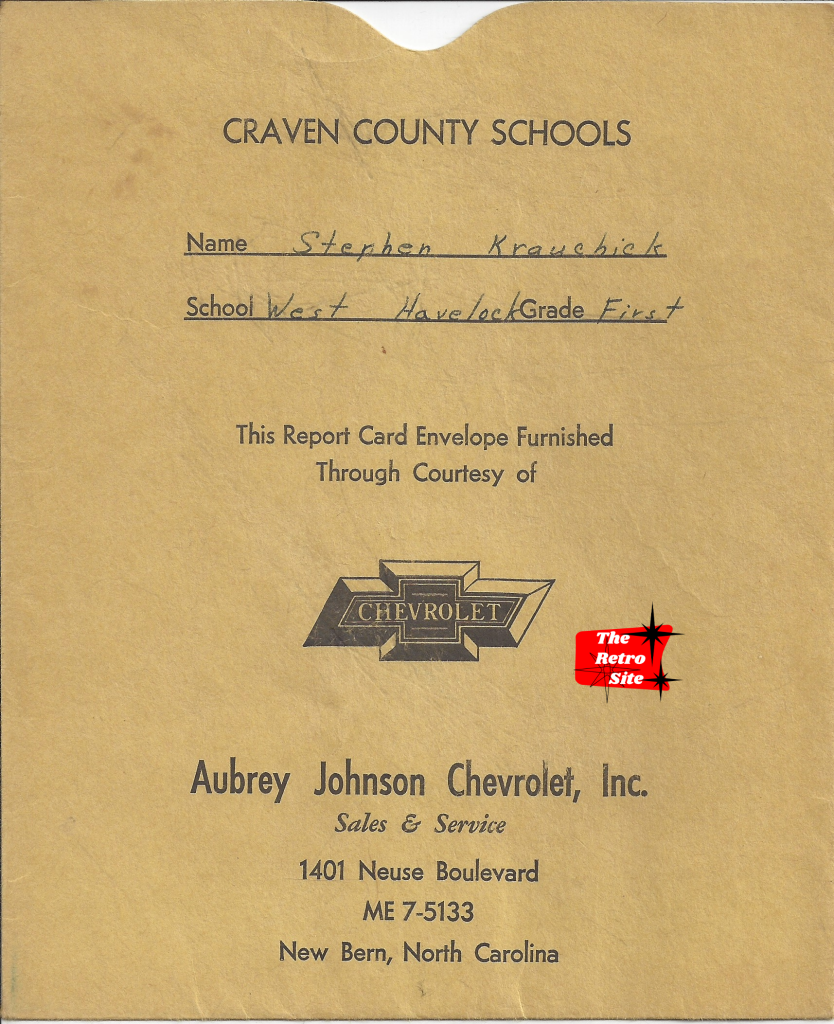
A recently found report card envelope from West Havelock School, belonging to first-grader Stephen Krauchick (RetroSite founder), offers a snapshot of a time when local businesses played a key role in supporting public education. Printed on sturdy kraft paper and bearing the Chevrolet bowtie logo, the envelope was provided courtesy of Aubrey Johnson Chevrolet, Inc. of New Bern, North Carolina.
From the 1940s through the 1970s, schools across America often relied on partnerships with local merchants to furnish essential printed materials. Budgets were limited, and items such as report card envelopes, homework folders, and event programs were commonly paid for by nearby businesses in exchange for advertising space. This arrangement not only saved schools money but also gave companies a unique and lasting presence in local households.
Chevrolet dealerships were among the most visible sponsors, leveraging their strong community ties to keep their names in front of families year-round. Each grading period, parents would see the dealership’s logo when reviewing their child’s progress—an inexpensive, high-impact form of marketing in an era before mass digital communication. These simple supplies were more than paper and ink; they were a reminder of the close-knit relationship between schools and the businesses that helped support them.
In the late 1960s, the makers of Maypo cereal launched a humorous twist on their famous “I Want My Maypo” slogan by recruiting some of the biggest names in sports. Baseball legend Mickey Mantle, football great Johnny Unitas, and basketball star Oscar Robertson—along with other sports icons—were featured in TV and print ads dramatically declaring, “I want my Maypo!”
The campaign, created by ad man George Lois, played off the tough, competitive images of these athletes by showing them in exaggerated, childlike poses, pleading for the maple-flavored oatmeal. Originally popularized in the 1950s by the animated character Marky Maypo, the slogan was given fresh life by this star-powered approach, turning a children’s breakfast cereal into a pop culture talking point. The ads became memorable for their unexpected humor and helped keep the brand in the public eye for years.
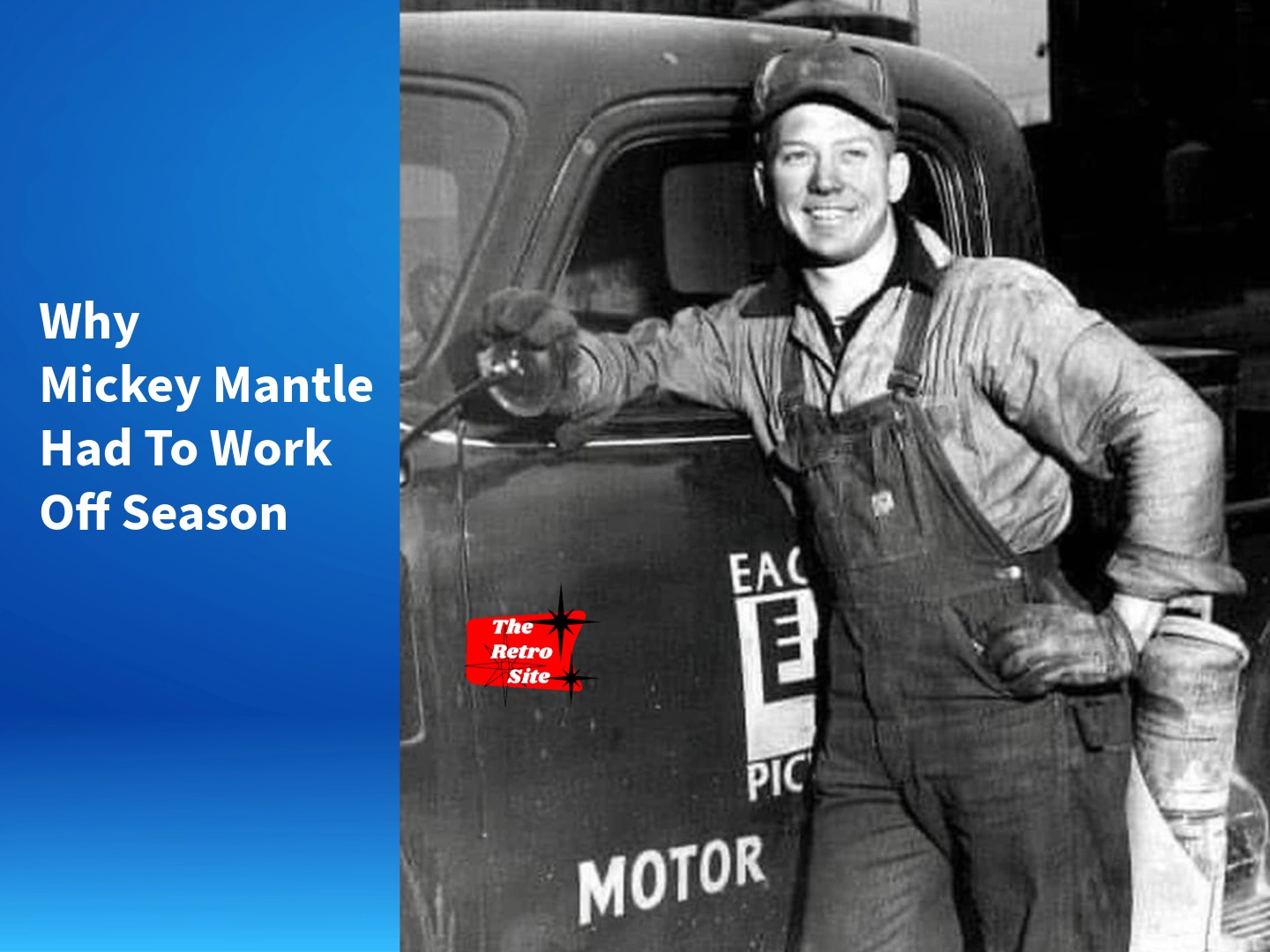
During Mantle’s early years in Major League Baseball — starting with his rookie season in 1951 — player salaries were modest compared to today. The reserve clause in players’ contracts bound them to one team, leaving them with little negotiating power. Mantle’s starting salary with the Yankees was $7,500 — respectable at the time but not enough to live on year-round or support a family.
To supplement his income, Mantle, like many of his teammates, took on blue-collar offseason jobs. Some of his offseason work included:
Working in the mines in Oklahoma (where his father and grandfather had also worked).
Operating a pump truck for an oil company, as suggested by the photo you provided.
Taking part in barnstorming tours (playing exhibition games).
Making appearances or working promotional gigs, once his fame grew.
Mantle’s Roots
Mickey Mantle grew up in Commerce, Oklahoma, a working-class mining town. His family had deep ties to manual labor — his father, Elvin “Mutt” Mantle, worked in the local lead and zinc mines. Mutt was also Mickey’s first and most dedicated baseball coach. This upbringing instilled a strong work ethic in Mickey, and he never saw himself as above a hard day’s work — even when he was the starting center fielder for the New York Yankees.
Mantle on Money and Work
Mantle once remarked on how little money there was in baseball when he started:
“I thought I was doing great when they paid me $7,500 my rookie year. I was just happy to be playing.”
He didn’t reach six-figure salaries until well into his career. By contrast, modern players can earn that much in a single at-bat.
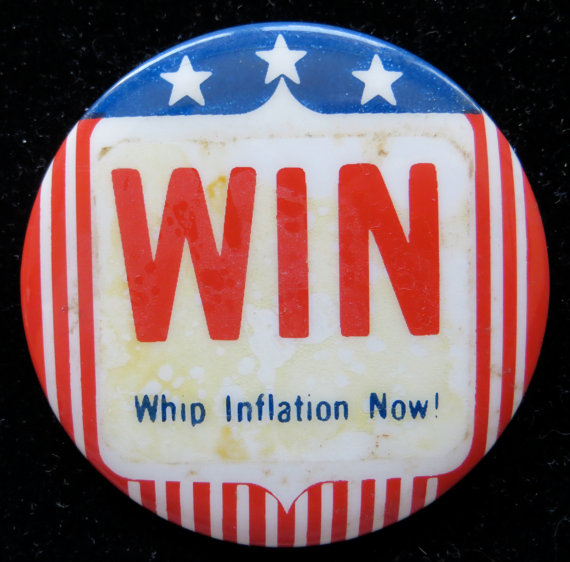
“WIN buttons” from the 1970s refer to a campaign launched by U.S. President Gerald Ford in 1974 called “Whip Inflation Now” (WIN). The campaign was part of Ford’s effort to combat the high inflation that plagued the U.S. economy during the mid-1970s.
Background
After the 1973 oil crisis and years of government spending on the Vietnam War and social programs, the U.S. faced rampant inflation.
President Ford addressed Congress on October 8, 1974, proposing a range of voluntary measures for Americans to curb inflation, such as conserving energy and reducing spending.
The WIN Campaign
WIN buttons were handed out as a form of patriotic encouragement. Americans were urged to wear them to show their commitment to fighting inflation.
The idea was that grassroots efforts—like saving money, avoiding waste, and boosting productivity—would help stabilize prices.
Public Reaction
The campaign was widely mocked and is often remembered as a failed public relations stunt.
Critics said the campaign lacked substance and placed too much responsibility on individuals rather than addressing deeper economic policies.
Some even wore the WIN buttons upside down, so they read “NIM”—interpreted as “Need Immediate Money.”
Legacy
Despite its failure, the WIN campaign is a memorable example of 1970s-era economic policy and presidential messaging.
It’s often cited in history and economics classes as a case study in how not to handle economic crises with symbolism over substance.
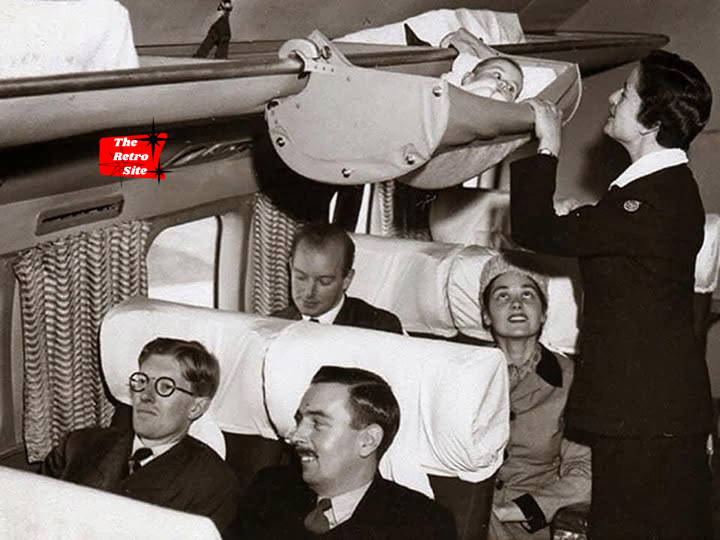
This vintage photo shows a fascinating glimpse into air travel from the 1950s. What you’re looking at is an old airplane cabin featuring an unusual amenity: a baby bassinet suspended above the seats, mounted to the overhead luggage rack.
These airborne bassinets were part of early commercial airliners’ efforts to accommodate families traveling with infants. The baby appears to be safely tucked into a canvas-style cradle, and a flight attendant is checking on the child while passengers below watch or relax.
This setup would never meet today’s safety standards, but at the time, it was seen as a convenient way to let parents rest while the baby was secured overhead.