Gumby!

https://www.theretrosite.com/wp-content/uploads/2026/08/0gumby-1.mp4

I think Gumby is one of those characters where several different generations can honestly say, “I grew up watching him.”

He actually goes all the way back to 1955, first appearing on Howdy Doody before getting his own NBC show. But what surprised me was how many little pieces of Art Clokey’s own life ended up in that simple green character. Gumby’s head was patterned after his father’s hairstyle in an old photograph, his big feet helped keep him standing during stop-motion filming, and Clokey chose green partly because he saw it as a color that didn’t represent any particular race.

Even the name has a story. Clokey’s father used the word “gumbo” for the clay-filled mud around Michigan farms, which eventually led to Gumbo, Gumba and little Gumby.

And Gumby almost came about accidentally. Clokey had made an experimental clay film called Gumbasia in 1953 after first working with clay professionally on a Budweiser commercial where he animated bites disappearing from a Swiss cheese sandwich. A producer saw Gumbasia and encouraged him to make clay characters for children’s television.

Then came another generation. College kids rediscovered Gumby, and in the early ’80s Eddie Murphy turned him into one of his memorable Saturday Night Live characters. That parody actually helped put the real Gumby back into the public eye.

So depending on your age, you might remember Gumby from the ’50s, the ’60s, reruns in the ’70s or his big ’80s comeback.

What era of Gumby do you remember watching?

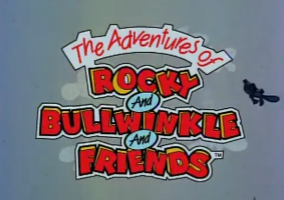
The Bullwinkle Show

https://www.theretrosite.com/wp-content/uploads/2026/08/00bulwinkle.mp4

I think one of the reasons Rocky and Bullwinkle still holds up is that when we watched it as kids, we probably weren’t getting half the jokes! The kids got a flying squirrel, a goofy moose and Boris and Natasha constantly trying to cause trouble, while the adults were getting political satire, pop-culture references and some pretty clever wordplay.

The show actually started in 1959 as Rocky and His Friends before moving to NBC in 1961 and becoming The Bullwinkle Show. What surprised me was how much talent was packed into those voices. Bill Scott, who played Bullwinkle, was also the show’s head writer and co-producer. June Foray voiced both Rocky and Natasha, Paul Frees played Boris, and that great narrator’s voice belonged to William Conrad, who many of us later knew as Cannon.

Here’s another one I didn’t know: Bullwinkle’s name reportedly came from a real person, Clarence Bullwinkel, who owned a car dealership near Berkeley and was known by creator Alex Anderson.

And despite how simple the animation sometimes looked, that almost became part of the charm. A lot of the animation work was done in Mexico to keep production costs down, while the writing remained incredibly sharp.

I went back to these cartoons expecting pure childhood nostalgia, but they’re actually funnier when you’re old enough to understand what the writers were sneaking past us!

Rocky and Bullwinkle

https://www.theretrosite.com/wp-content/uploads/2026/07/0bull.mp4

Rocky and Bullwinkle was one of those cartoons that worked on two levels. Kids saw a flying squirrel, a goofy moose, spies, fairy tales, and silly adventures. Adults heard the puns, political jokes, Cold War humor, and smart little digs that went right over a lot of kids’ heads.

The show began in 1959 as Rocky and His Friends on ABC, then moved to NBC in 1961 as The Bullwinkle Show. Rocky was Rocket J. Squirrel, the brave flying squirrel, and Bullwinkle J. Moose was his well-meaning but not always brilliant best friend from Frostbite Falls, Minnesota. The show originally ran until 1964, with reruns continuing for years, including ABC Sunday mornings into the early 1970s.

What made it different was the variety-show style. You did not just get Rocky and Bullwinkle fighting Boris Badenov and Natasha Fatale. You also got Fractured Fairy Tales, Peabody’s Improbable History with Mr. Peabody and Sherman, Aesop and Son, Dudley Do-Right, Bullwinkle’s Corner, and all those cliffhanger endings with ridiculous titles.

The animation was not fancy, even for its time, but the writing was the real star. Jay Ward and Bill Scott leaned into wordplay, satire, narrator jokes, and absurd situations. That is why Rocky and Bullwinkle still feels different from a lot of old cartoons. It was funny for kids, but it was also sneaky smart for the adults in the room. UCLA’s Hammer Museum called the series a “rare gem” and credited its wit to the Jay Ward team, including Bill Scott, June Foray, and the show’s writers and animators.

Magilla Gorilla

https://www.theretrosite.com/wp-content/uploads/2026/06/0magilla.mp4

Magilla Gorilla was one of those classic Hanna-Barbera characters who was impossible not to like. Sitting in Mr. Peebles’ pet shop with his little hat, bow tie, suspenders, and endless supply of bananas, Magilla was always waiting for someone to take him home.

Of course, every time someone did, it usually went wrong — and poor Mr. Peebles would end up with Magilla right back in the window.

Do you remember watching Magilla Gorilla?

Mighty Mouse: Here He Comes To Save The Day

https://www.theretrosite.com/wp-content/uploads/2026/06/Mighty-Mouse.mp4

Mighty Mouse Playhouse first aired on CBS Saturday mornings, beginning December 10, 1955. That date is important because the show helped put the idea of Saturday morning cartoons on the map.

Mighty Mouse had actually started earlier in theatrical cartoons from Terrytoons, debuting in the 1942 short The Mouse of Tomorrow. But TV is what made him a household name. CBS repackaged the older Mighty Mouse cartoons for television, and suddenly kids could see him right at home instead of at the movie theater.

The show had everything kids loved: a tiny hero with super strength, flying rescues, villains, danger, and that unforgettable theme line: “Here I come to save the day!” Mighty Mouse usually showed up just in time to save the helpless and defeat the bad guys.

Looking back, Mighty Mouse Playhouse feels simple now, but it was a big deal. It helped prove that Saturday morning could belong to kids, cereal bowls, pajamas, and cartoons.

Mr. Magoo: The Man Who Couldn’t See Trouble Coming

https://www.theretrosite.com/wp-content/uploads/2026/06/mr-magoo.mp4

Mr. Magoo was one of those cartoon characters built around one joke that somehow kept working: he could barely see, refused to admit it, and still managed to stumble through danger without realizing how close he came.

His full name was Quincy Magoo, and he first appeared in the 1949 UPA cartoon The Ragtime Bear. The character was voiced for decades by Jim Backus, who later became just as famous as Thurston Howell III on Gilligan’s Island.

The humor was simple. Magoo would mistake one thing for another, walk into ridiculous situations, and somehow come out fine while everyone around him panicked. His famous line was:

“Oh, Magoo, you’ve done it again!”

What made Mr. Magoo stand out was that he wasn’t a talking animal or superhero. He was a stubborn little old man with terrible eyesight and total confidence. The cartoons had a sharp, modern look compared to a lot of animation at the time, and Magoo became one of UPA’s signature characters.

He later moved into TV cartoons, specials, commercials, and even holiday programming. Looking back, Mr. Magoo is definitely a product of his time, but for many of us, he’s still remembered as that squinty little guy who caused chaos everywhere he went and somehow never knew it.

The World of Commander McBragg

https://www.theretrosite.com/wp-content/uploads/2026/06/commander-mcbragg.mp4

The World of Commander McBragg was one of those quick little cartoon shorts that showed up inside other shows, especially Tennessee Tuxedo and His Tales and later syndicated cartoon packages. The shorts were usually only about 90 seconds, but they packed in a whole tall tale before moving on.

Commander McBragg was a retired British-style officer and gentleman who loved telling outrageous stories about his impossible adventures. He would buttonhole some poor listener at his club, point to a map or globe, and launch into a story about the time he survived some ridiculous danger. Of course, the name said it all: McBragg. He was always bragging.

The humor came from how seriously he told these completely unbelievable adventures. Giant birds, dangerous jungles, impossible escapes, wild animals, lost valleys, flying machines, and whatever else the writers could dream up. At the end, he would usually survive by some absurd bit of cleverness, then calmly accept praise as if it had all been perfectly normal.

The character’s deep, gravelly voice was done by Kenny Delmar, who had been famous on radio as Senator Claghorn, the character who helped inspire Foghorn Leghorn.

Looking back, Commander McBragg was basically a cartoon version of that old uncle or neighbor who always had a bigger, better, wilder story than everyone else. You didn’t believe a word of it, but you still wanted to hear how he got out of it.

Tennessee Tuxedo: The Penguin Who Tried, But Couldn’t Succeed-o

https://www.theretrosite.com/wp-content/uploads/2026/06/tenesee-tuxedo-1.mp4

Tennessee Tuxedo and His Tales was a Saturday morning cartoon that aired on CBS from 1963 to 1966. It starred Tennessee Tuxedo, a penguin in a hat and bow tie, and his loyal but dim pal Chumley the walrus. They lived at the Megapolis Zoo and were always trying some new scheme that usually went wrong fast.

Tennessee was voiced by Don Adams, before Get Smart made him a household name. Once you know that, you can hear a little Maxwell Smart in Tennessee’s voice. Chumley was voiced by Bradley Bolke, and Larry Storch voiced the brilliant Phineas J. Whoopee, the professor who explained things with his famous 3DBB, the “three-dimensional blackboard.”

That was the sneaky educational part of the show. Tennessee and Chumley would get into trouble, then Mr. Whoopee would explain science, history, or how something worked, but it didn’t feel like school because the cartoon was still silly.

Looking back, it had that classic early Saturday morning feel: simple animation, funny voices, a catchy theme, and just enough learning hidden inside the laughs. Tennessee may have tried and failed a lot, but the show stuck around in a lot of memories.

The New Casper Cartoon Show: The Ending We Remember

https://www.theretrosite.com/wp-content/uploads/2026/06/casper-outro.mp4

If you watched The New Casper Cartoon Show on Saturday mornings, the ending probably brings back just as many memories as the opening.

These are the Casper episodes I’m most familiar with, so seeing the closing again feels like finding an old piece of childhood TV you forgot was still tucked away somewhere. Casper was never the scary kind of ghost. He was gentle, lonely, and always just trying to make a friend.

The show first aired on ABC Saturday mornings in 1963, with new cartoons made for TV along with older Casper shorts. It gave Casper a regular place in the Saturday morning lineup, alongside characters like Wendy the Good Little Witch, The Ghostly Trio, Spooky, and Nightmare the ghost horse.

The ending has that simple old-TV charm. No big production, no loud cliffhanger, just a friendly goodbye from a cartoon that was never trying to be too wild or too scary.

For many of us, this version of Casper is the one that stuck: cereal bowl nearby, TV glowing, and a friendly ghost reminding us that sometimes the nicest character on television was the one everyone else was supposed to be afraid of.

The New Casper Cartoon Show

https://www.theretrosite.com/wp-content/uploads/2026/06/casper-intro.mp4

These are the Casper episodes I’m most familiar with, and it’s good to see them all once again.

The New Casper Cartoon Show first aired on ABC Saturday mornings in 1963, with its original run continuing into early 1964. It included 26 new Casper cartoons made for TV, along with older theatrical cartoons that helped keep Casper on television for years afterward.

Casper had already been around before this show, appearing in theatrical cartoons and Harvey Comics, but this version gave him a regular Saturday morning home. Unlike most ghosts, Casper didn’t want to scare anyone. He just wanted friends, which made him one of the gentler cartoon characters of the era.

The show also featured familiar Harvey characters like Wendy the Good Little Witch, The Ghostly Trio, Spooky, and Nightmare the ghost horse.

Casper would return in later forms too, including Casper and the Angels in the late 1970s and other Harvey cartoon packages that kept him alive for new generations of kids. But for many of us, The New Casper Cartoon Show is the version that feels like Saturday morning: cereal, pajamas, and a friendly ghost who was never too scary.

Exit mobile version