online community focused on sharing and reminiscing about video, audio, and images that stir our memories of the past – old television, theme songs, commercials, print advertisements, the sights and sounds you remember
Chatty Cathy was one of the dolls that made kids stop and stare back in the early 1960s. Introduced by Mattel in 1960, she became famous because she did more than just sit there looking cute. Pull the string, and Chatty Cathy would actually talk.
Her voice was provided by June Foray, who also voiced Rocky the Flying Squirrel, and the doll became such a pop culture memory that she even helped inspire the creepy “Talky Tina” doll from The Twilight Zone. Decades later, GEICO used a Chatty Cathy-style parody in a commercial, proving that people still remembered the idea of the pull-string doll that just would not stop talking.
Sweet, simple, and a little bit magical, Chatty Cathy became one of the great talking toys of the era.
It was great the first day you got the track, but the fun didn’t stop there. A new car didn’t cost all that much, even for a kid, and suddenly the whole race changed. One new car meant new matchups, new winners, new arguments, and another reason to reset the track and try again.
Hot Wheels were introduced by Mattel in 1968, created to compete with Matchbox, but they had a completely different attitude. Matchbox cars looked more like regular cars you’d see on the road. Hot Wheels looked like something a kid dreamed up: wild colors, big wheels, racing stripes, spoilers, flames, and hot rod styling. The first line is remembered as the “Original 16” or “Sweet 16.”
And they were fast. That was the magic. Mattel built them with low-friction wheels and axles, wider hard-plastic tires, and a suspension design that helped them fly down those orange plastic tracks smoother than other little cars of the time. The Strong National Museum of Play notes that Mattel engineers wanted them to “zoom,” using thick plastic mag wheels, minimal-friction axles, and torsion-bar suspension.
Then came the tracks. If you got a new setup, like the one with the Super Charger, it worked with the track you already had. That was the genius of it. You didn’t have to start over. You just added on. A curve here, a loop there, a launcher, a jump, and suddenly your living room floor became Daytona, Indy, and a demolition derby all at once.
Looking back, Hot Wheels were a great value because every piece made the whole thing better. One car could change the race. One track set could change the whole afternoon. And for a kid, that little orange track and one fast car were enough to make the whole room feel like a speedway.
Leave it to the early 1980s to give us a controversy over a baby doll’s bare bottom.
Mattel’s Tippee-Toes was one of those dolls that was supposed to look cute, innocent, and lifelike. She could crawl, and like a lot of toy commercials from back then, the ad was aimed right at kids sitting in front of the TV, probably during cartoons or family programming. But then came the part that got people talking: the commercial showed the doll’s little bare backside.
That may sound pretty tame today, but back then one viewer found it offensive enough to complain to David Horowitz, the consumer advocate best known for Fight Back! with David Horowitz. Horowitz was the guy people turned to when they felt a product, commercial, or company needed to be called out. He built a career on standing up for consumers, testing products, and bringing viewer complaints into the spotlight.
The issue even made its way to The Tonight Show Starring Johnny Carson in 1982. Horowitz appeared on Carson and discussed the Tippee-Toes commercial, reportedly showing both the original ad and the changed version after complaints were made. It was one of those perfect Johnny Carson moments where something small, silly, and strangely serious all came together on national television.
Looking back, it feels almost impossible to believe this was a controversy. We grew up with talking dolls, creepy ventriloquist dummies selling chocolate milk, clowns selling cereal, and commercials that would probably send today’s internet into a panic. But a baby doll’s bare bottom? That was enough to get a consumer advocate involved and Mattel’s attention.
It’s a funny little reminder of how much TV, advertising, and what people considered “offensive” has changed over the years. Tippee-Toes was just trying to crawl across the screen, but somehow she crawled right into consumer TV history.
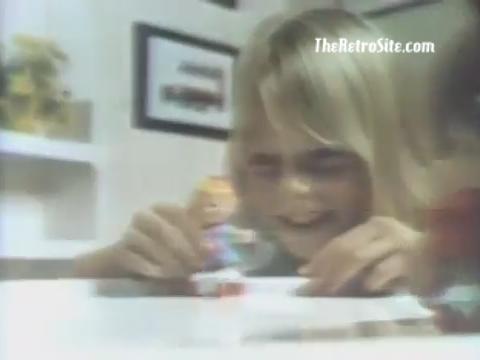
Before Jodi Foster hit the big screen she was a frequent visitor to
the TV in commercials. Here she is in 1971 advertising Mattel’s Small
Shots. Small Shots were a version of Hot Wheels. The three-inch skaters
were mounted on a 4 wheel base and were boxed with a jump ramp. Skate ‘N
Race Sets sets had additional characters like Hot Red and Sillie Millie
and Breezy Bridgit was sold separately. Red Hot Red and Sillie Millie
were sold in the in the Skate ‘N Race Sets.
Small shots were
also able to run on Hot Wheel Tracks including to super charger! They
were manufactured until 1973. Today individual characters can fetch $30
to $40 if in good condition and the Skate ‘N Race Sets will get you $200
to $300.