You Get A Quick Tan With QT !

https://www.theretrosite.com/wp-content/uploads/2026/05/QT.mp4

1963 was a little early for me to go out and get a quick tan. I just did it the old-fashioned way — by playing outside! But I sure remember the jingle.

Back then, nobody thought much about sunscreen warnings. You went outside, rode bikes, played ball, ran around the neighborhood, and by the end of summer you had the tan lines to prove it.

QT promised color without baking in the sun, which sounds funny now because self-tanners later became famous for streaks, blotches, and that dreaded orange look. But in that era, tanning was sold as healthy, glamorous, and fashionable.

Looking back, QT feels like a perfect little time capsule: a bottle promising summer color on demand, indoor or outdoor, rain or shine. Before spray tans, tanning beds, bronzers, and modern sunscreen warnings, there was Coppertone QT telling everyone they could hurry up and get tan.

The Rat Patrol

The Rat Patrol was another one of those shows Dad loved to watch, and to a kid, it sure looked promising. Jeeps tearing across the desert, guns mounted in the back, bombs going off, aircraft overhead — it had all the ingredients that should have grabbed a young viewer right away.

But at that age, the dialogue went right over my head. I was there for the action, not the strategy. The show followed a small Allied commando unit during World War II, racing through the North African desert and taking on German forces in fast-moving missions. It was part war show, part adventure series, and part Saturday afternoon action movie squeezed into a half-hour.

The Rat Patrol aired from 1966 to 1968 and starred Christopher George as Sgt. Sam Troy. One of the more interesting cast members was Hans Gudegast, who played German Capt. Dietrich. Soap fans would later know him much better as Eric Braeden from The Young and the Restless.

The show was loosely inspired by real desert raiding units like the British SAS and the Long Range Desert Group, but Hollywood gave it a very American spin. That bothered some viewers overseas because the real North African desert raids were largely a British and Commonwealth story, while the TV version put American characters front and center. The BBC reportedly pulled the show after only a few episodes because of complaints about that Americanized version of the war.

Looking back, I can see why Dad liked it. It had action, military drama, and just enough grit to feel grown-up. For us kids, it was the jeeps and explosions that pulled us in, even if we didn’t always understand what they were talking about once the shooting stopped.

Stop the Pigeon!

https://www.theretrosite.com/wp-content/uploads/2026/05/Dasterd-to-post.mp4

Dastardly and Muttley in Their Flying Machines was one of those cartoons built around one simple idea that somehow worked every time: stop the pigeon.

The show came from Hanna-Barbera in 1969 and brought back Dick Dastardly and Muttley from Wacky Races. This time, they were part of the Vulture Squadron, flying ridiculous contraptions and trying every week to catch Yankee Doodle Pigeon.

Of course, they never did.

The real star was Muttley. That wheezy little laugh was funnier than half the script, and his constant demand for medals made him even better. Dastardly would scheme, Muttley would snicker, the plane would fall apart, and the pigeon would fly away.

Looking back, most of us probably weren’t rooting for the pigeon. We were watching for Dastardly to lose his temper, Muttley to laugh, and that theme song to get stuck in our heads all over again.

Stop the pigeon, stop the pigeon!

Speed Racer: Our First Taste of Anime Before We Knew the Word

https://www.theretrosite.com/wp-content/uploads/2026/05/speedPost.mp4

Speed Racer was one of those cartoons that felt different the second it came on. The theme song hit, the Mach 5 took off, and suddenly we were watching cliffs, crashes, secret buttons, masked racers, gangsters, and more danger than most Saturday morning cartoons dared to show.

The show began in Japan as Mach GoGoGo in 1967 before becoming Speed Racer for American audiences. Most of us didn’t know we were watching anime back then. We just knew it didn’t feel like Bugs Bunny, Scooby-Doo, or the usual superhero cartoons.

Compared to American cartoons of the time, Speed Racer was faster, stranger, and more dramatic. There were revenge plots, family secrets, real danger, and Racer X lurking around like something out of a spy movie. The animation could be limited, but the style made up for it with speed lines, dramatic close-ups, wild crashes, and that nonstop rapid-fire dialogue.

And of course, there was the Mach 5. What kid didn’t want a car with buttons that could jump, saw through trees, go underwater, and somehow survive every impossible race?

Looking back, Speed Racer was a lot of kids’ first introduction to anime, even if we didn’t have that word yet. It was loud, weird, exciting, and unforgettable.

When Aftershave Came With Self-Defense Instructions

https://www.theretrosite.com/wp-content/uploads/2026/05/0hai.mp4

Hai Karate was one of those aftershaves that sold the joke as much as the scent.

It launched in 1967 and the whole idea was that the stuff made a man so irresistible that women would practically attack him. That is why the package and commercials leaned into the gag that every man needed self-defense instructions after putting it on. The famous warning was: “Be careful how you use it.”

The commercials were pure 1960s and early 1970s male fantasy advertising. A regular guy splashes on Hai Karate, and suddenly a woman goes wild for him. He has to use goofy karate moves to fend her off. It was played for broad slapstick laughs, with the martial arts craze and the “irresistible aftershave” idea mashed together into one very memorable campaign.

The campaign came from the ad firm McCaffrey & McCall, and one of the people behind the marketing plan was George Newall, who later became famous as a co-creator and songwriter for Schoolhouse Rock!

Looking back, it feels like the granddaddy of those later body spray ads where one spritz supposedly turns you into a babe magnet. Back then, though, Hai Karate had the extra gimmick: not only would women chase you, but you might need to defend yourself afterward.

It was silly, sexist, over-the-top, and very much of its time. But that is exactly why people remember it. The bottle may have been aftershave, but the real product was the joke.

“Brylcreem, a little dab’ll do ya…”

https://www.theretrosite.com/wp-content/uploads/2026/05/05072.mp4

That line was everywhere. The ads promised you didn’t need much, just a small dab, and suddenly you’d look sharp, smooth, and “debonair.” The jingle was credited to Hanley M. Norins of the Young & Rubicam advertising agency.

Of course, the best part was the promise that “the gals’ll all pursue ya” and love running their fingers through your hair. That was peak old-school advertising: use the product, look handsome, and suddenly romance is chasing you down the street.

By the 1960s, the Beatles and the dry, natural hair look started making heavily slicked hair seem old-fashioned, so Brylcreem had to adjust its pitch. But for anyone who grew up hearing that jingle, “a little dab’ll do ya” is still one of those lines that instantly brings back a whole era of bathroom mirrors, combs, crew cuts, and Dad’s medicine cabinet.

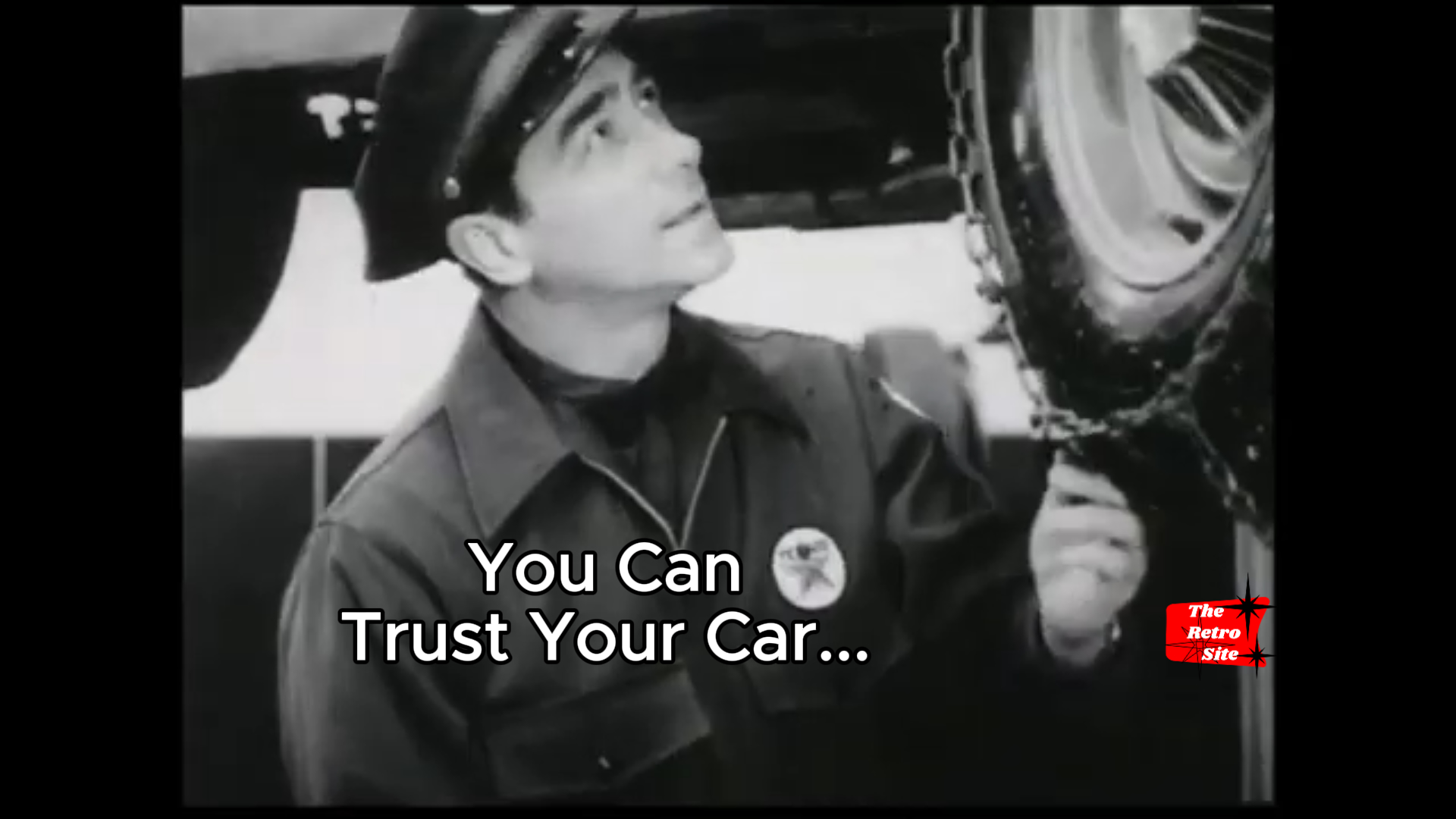
You Can Trust Your Car…can you finish it?

https://www.theretrosite.com/wp-content/uploads/2026/05/0texaco.mp4

You Can Trust Your Car to the Man Who Wears the Star was one of those great old advertising lines that stuck in your head because it did exactly what a slogan was supposed to do: it made the brand feel safe, familiar, and dependable.

Texaco’s “star” was right there in the logo, and the “man who wears the star” was the service station attendant. Back then, gas stations were not just places where you pumped your own gas and left. An attendant might check your oil, clean your windshield, look at your tires, and give the car a quick once-over while you sat behind the wheel. The campaign sold Texaco as more than gasoline. It sold trust.

The slogan became closely tied to Texaco’s image during the full-service gas station era. The message was simple: pull into Texaco, look for the star, and you were in good hands. It fit perfectly with the time, when uniformed attendants and branded service stations were part of the American road trip experience.

The jingle is most commonly credited to Roy Eaton, a pioneering Black advertising composer who worked on major campaigns including Texaco and Chef Boyardee Beefaroni. One profile says Eaton created the Texaco jingle in 1962, and another notes it was recognized by Advertising Age as part of one of the top ad campaigns of the 20th century. As for who sang the original version, that part is less clear. The safest answer is that it was likely performed by commercial session singers over the years, with different versions used in different Texaco spots.

The line worked because it sounded almost like a jingle before you even heard the music. “You can trust your car to the man who wears the star” has that smooth, sing-song rhythm that made it easy to remember. Texaco also used another famous star-themed line, “Star of the American Road,” leaning heavily into the red star logo as a symbol of dependability.

Looking back, it is a reminder of when gas stations felt more personal. The “man who wears the star” was not just selling gas. He represented service, pride, and that old-school promise that somebody actually knew your car and cared whether you made it down the road.

Mahna Mahna

https://www.theretrosite.com/wp-content/uploads/2026/05/0Mahna-Mahna.mp4

Mahna Mahna is one of those nonsense songs that somehow parked itself in everyone’s brain forever.

Most of us remember it from The Muppets, with the shaggy little “Mahna Mahna” character singing the goofy lead while the two pink creatures, the Snowths, answer back. But the song actually started in a very different place. It was written by Italian composer Piero Umiliani for the 1968 Italian film Svezia, inferno e paradiso, released in English as Sweden: Heaven and Hell.

Then Jim Henson and company turned it into something completely different. The Muppets performed it on Sesame Street in 1969, then on The Ed Sullivan Show, and later it became one of the memorable sketches from the first episode of The Muppet Show in 1976.

The funny part is, the lyrics don’t mean anything. That’s the whole charm. It’s just a silly call-and-response tune, but once you hear it, good luck getting it out of your head. Like a lot of the best Muppet moments, it worked because it was simple, weird, and somehow hilarious without needing a real punchline.

Did You Watch Super Chicken?

Super Chicken was one of those cartoons that felt like it was made for kids, but the jokes were flying right over our little heads and landing with the grown-ups. It was part of George of the Jungle, which aired on ABC starting in 1967, along with the other segments Tom Slick and Super Chicken. It came from Jay Ward Productions, the same folks behind Rocky and Bullwinkle, so you knew it was going to be loaded with silly names, smart-aleck humor, and jokes that moved faster than most of us realized at the time.

Super Chicken’s real name was Henry Cabot Henhouse III, because of course it was. He was a wealthy chicken superhero who would head off to fight crime with his lion sidekick Fred. And poor Fred always seemed to take the worst of it, which led to that famous line: “You knew the job was dangerous when you took it, Fred!” That was the kind of cartoon writing I appreciate more now than I probably did back then.

The whole thing only had 17 original episodes as part of George of the Jungle, but like so many Saturday morning cartoons, it lived a lot longer in reruns and in our memories. Between the theme song, the goofy superhero setup, and that classic Jay Ward humor, Super Chicken was one of those quick little cartoons that didn’t need much time to leave a mark.

Who remembers Super Chicken? And did you watch it for him, George of the Jungle, or Tom Slick?

Glen Campbell’s Country Spectacular

https://www.theretrosite.com/wp-content/uploads/2026/05/00glen.mp4

Glen Campbell’s Country Special from January 11, 1972 was one of those old-school TV nights where the whole living room got a free country concert. Glen wasn’t alone either. He had Johnny Cash, June Carter, Merle Haggard, Buck Owens, Freddie Hart, Jerry Reed, Minnie Pearl, and Mel Tillis all showing up like it was nothing. Today, that would be a major streaming event. Back then, it was just Tuesday night television.

That’s what made variety shows so great. You didn’t have to buy a ticket, search YouTube, or subscribe to anything. You just turned on CBS and there was Glen Campbell, smooth as ever, picking and singing with some of the biggest country stars of the era. Do you remember watching Glen’s show, or were your parents the ones who had control of the TV when country music came on?

Exit mobile version