



Now this is Halloween shopping, 1970s style! Woolworth and Woolco had the costumes, the candy, and even a record to supply the spooky sounds. Complete costumes for $1.83 to $3.99—and somehow those plastic masks could make the Bionic Woman look scarier than the monsters!
⠀
I always get a kick out of those old costumes with the character’s picture printed right on the front. You weren’t simply dressed as Superman—you were wearing an advertisement explaining that you were Superman. There was actually a reason for that: Ben Cooper considered the costume front a wearable billboard, designed to make the character instantly recognizable.
⠀
Those inexpensive costumes took more work than you might think. According to Ira Cooper, whose family ran the company, developing one normally took about nine months. Artists, sculptors, engineers, and fabric workers all had a hand in turning a familiar television or comic-book face into Halloween merchandise.
⠀
And that Sounds to Make You Shiver record wasn’t something created just for the commercial. Pickwick was already promoting it in 1973. Before we could pull up spooky sounds on a phone, we could put a haunted house on the turntable!
⠀
Woolworth’s American stores disappeared in 1997, but commercials like this bring back an entire way of shopping. What was your favorite Halloween costume growing up—and did it come in a box with a plastic mask?
⠀
#Woolworth #Woolco #VintageHalloween #HalloweenNostalgia #BenCooper #1970s #TheRetroSite
Tag: 1970s commercials
FUNYUNS — THE SNACK THAT ALMOST WASN’T CALLED FUNYUNS
This commercial takes me right back to when a bag of Funyuns seemed like one of the strangest snacks in the chip aisle. They looked like little onion rings, tasted like onions and even had a name that sounded like somebody made it up on the spot. As it turns out, somebody pretty much did!
Funyuns were introduced by Frito-Lay in 1969, created by employee George Wade Bigner. But here’s something I never knew: Funyuns weren’t supposed to be called Funyuns. The original name was OnYums, but that name was already taken. Advertising copywriter Jim Albright came up with “Funyuns” instead, and more than half a century later we’re still calling them that.
And listen closely to the music in these early commercials. The tune came from “I Love Onions,” a wonderfully odd 1966 novelty song recorded by Susan Christie. The song actually made the Billboard Hot 100 before its melody was adapted to help sell Funyuns.
Another great connection: in 1971, a young Roger Enrico went to work marketing Funyuns. He eventually became CEO of PepsiCo and was one of the men behind Pepsi’s blockbuster Michael Jackson era. Not a bad career beginning for a guy working on onion-flavored rings!
And yes, Funyuns are still around today.

“Ever Eat a Pine Tree?” — The Commercial That Turned Euell Gibbons Into a Punchline
This may be one of those commercials where one sentence became much more famous than the product being advertised.
Euell Gibbons looks into the camera and asks:
“Ever eat a pine tree? Many parts are edible.”
And if you were watching television in the early ’70s, apparently there was no escaping what happened next!
I found contemporary FTC records for this exact Grape-Nuts commercial dating it to 1972, even though it’s often identified today as a 1974 spot. Gibbons wasn’t some eccentric actor they hired either. He was a respected author and wild-food expert whose Stalking the Wild Asparagus had been around since 1962.
But that pine-tree line turned him into a pop-culture phenomenon.
John Byner spoofed him on The Carol Burnett Show, Johnny Carson made tree-eating jokes, and Match Game used Euell Gibbons repeatedly as material. One question joked that he had eaten the television camera! Even The Electric Company created “Early Gibbons,” who ate stumps, sticks and stones.
Gibbons even got into the act himself. When Sonny and Cher handed him what appeared to be a wooden plaque, he took a bite out of it. It was actually made to be edible.
And all those jokes certainly didn’t hurt Grape-Nuts. By the end of 1973, the advertising trade press reported that his commercials had increased sales by about 30 percent.
There was one unexpected ending. In 1975, the FTC stopped commercials showing wild plants as edible because regulators worried children might imitate Gibbons and eat something dangerous.
More than 50 years later, say Euell Gibbons to someone who remembers the ’70s and there’s a pretty good chance they’ll answer with something about eating a pine tree.
Do you remember the original commercial — or do you remember all the jokes about Euell Gibbons even more?

Before Taxi, Judd Hirsch Was Selling Us Listerine
Take another look at the young radio DJ in this commercial. That’s Judd Hirsch, years before Taxi, Ordinary People and the long career we know him for today.
This spot appears to be from around 1970, when Hirsch was still trying to establish himself as an actor and doing commercials to make a living. What I didn’t know was that before acting, he had earned a degree in physics and actually worked as an engineer. A few years after this commercial, his career began taking off, and by 1978 he was Alex Rieger on Taxi, eventually winning two Emmys for the role.
But the other star here may really be Listerine’s advertising.
Most companies tried desperately to convince us their products tasted good. Listerine basically said the opposite. Its famous campaign was “The taste people hate twice a day.” In other words, yes, it tastes awful — but that must mean it works!
And boy did we believe that.
Listerine had actually been around since 1879, originally developed as an antiseptic rather than an everyday mouthwash. By the 1920s, advertising helped make the word “halitosis” part of the American vocabulary and convinced generations that bad breath could ruin everything from a date to a marriage.
Looking back, I think the burning sensation became part of Listerine’s identity. You swished it around, tried desperately to make it the full 30 seconds, and then came up gasping for air!
And sitting there in this old commercial is a young Judd Hirsch, probably with no idea that millions of us would someday know him as one of television’s most familiar faces.
Did you recognize Judd Hirsch right away — and be honest, how long could you actually keep old-fashioned Listerine in your mouth?

Jiffy Pop — Was It More Fun to Make Than Eat?
It’s Friday night, and this one brings back that whole feeling of the weekend finally being here. Maybe there was a movie coming on TV, maybe we were allowed to stay up a little later, and somehow popcorn just seemed to belong with Friday night. And if somebody pulled out a Jiffy Pop, making the popcorn became part of the entertainment. Standing at the stove, shaking that pan back and forth and watching the foil slowly puff up was almost as much fun as eating what was inside.
There was popcorn, and then there was Jiffy Pop, where half the entertainment was watching that aluminum foil grow into a giant silver ball.
Looking this one up, I found that Jiffy Pop goes all the way back to 1959, but it wasn’t actually the first popcorn sold this way. A product called E-Z Pop had been around since 1954, and its manufacturer eventually sued Jiffy Pop’s makers for patent infringement. The case went all the way to a federal appeals court, where Jiffy Pop won in 1963 partly because its foil expanded differently.
The magician connection in these 1970s commercials wasn’t just advertising make-believe either. Harry Blackstone Jr. was a genuine professional magician, and in 1976 Jiffy Pop was promoting the product as “the magic treat.” Blackstone came from quite a magic family — his father was The Great Blackstone, one of America’s best-known illusionists and a contemporary of Harry Houdini.
Harry Jr. went on to become a major star himself. He was twice named Magician of the Year by the Magic Castle, took his show to Broadway in 1980 and later donated his family’s famous floating-light-bulb illusion to the Smithsonian.
And Jiffy Pop certainly outlasted these commercials. It even had a memorable role in the opening of Scream in 1996.
Best of all, Jiffy Pop is still being made today. Some products really don’t need much improving — watching that foil balloon get bigger was the whole experience!
Since it’s Friday night, this seems like the perfect one to ask:
What memories does Jiffy Pop bring back for you — family movie nights, staying up late watching TV, or trying not to burn the bottom?

Cathy Rigby Built Quite a Career After the Olympics
This old Cathy Rigby Stayfree commercial brings back a completely different Cathy Rigby memory for me.
Back in the 1990s, I worked as a Communications Specialist at Caldor’s corporate headquarters in Norwalk. We were opening a new store in Pennsylvania and Cathy Rigby was there to meet customers and sign autographs. What I remember most about her personally was how soft-spoken and very polite she was. Nothing flashy at all, and that stuck with me.
Most of us remember Cathy first as the young American gymnast who became one of the faces of the sport. She competed in the 1968 and 1972 Olympics, but something I had forgotten is that her most historic medal didn’t come at the Olympics. In 1970, she won silver on the balance beam at the World Championships, becoming the first American gymnast ever to win a World Championships medal.
After retiring from competition, she did something a lot of famous athletes struggle to do — she kept finding ways to turn that recognition into a long career.
There were the Stayfree commercials, which became one of her best-known endorsement campaigns. She also spent 18 years covering gymnastics for ABC Sports, did other television and fitness work, and then built a whole second career on stage.
And that second career became huge. Rigby began playing Peter Pan in the 1970s and returned to the role for decades, eventually earning a Tony nomination in 1991. She and her husband also moved into producing through McCoy Rigby Entertainment.
Then there’s Caldor itself, another memory for a lot of us. The chain was founded in 1951 by Carl and Dorothy Bennett, and even the name came from them — CAL from Carl and DOR from Dorothy. By the time I worked there, it had grown into one of the Northeast’s best-known discount chains.
So for me, this commercial connects three different things: a familiar face from television, a remarkable post-Olympic career, and my own memory of meeting Cathy Rigby years later through Caldor.
Do you remember her most from gymnastics, the Stayfree commercials, Peter Pan, or somewhere else?

Flatsy Dolls: They Were Flat and That Was That!
Here’s one that really could only have come out of the late 1960s — Flatsy, the doll whose big selling point was that she was…flat!
But there was actually more thought put into these than I remembered. The dolls were made of soft vinyl with wire inside so you could bend and pose them, and some came mounted in decorative frames that could actually be hung on the wall. You could even wear some of the dolls on your clothes.
I found something interesting in a 1968 issue of Broadcasting magazine: Ideal was already planning network and major-market advertising for its new Flatsys beginning February 1, 1969. The line lasted until 1973 and grew well beyond the dolls in this commercial, with Fashion Flatsys, mini versions, Flatsyville, Candy Mountain and different playsets.
Even the company behind them has a great story. Ideal traced its beginnings to Morris and Rose Michtom, the couple associated with creating the original American Teddy bear after Theodore Roosevelt’s famous 1902 hunting incident.
And somehow that little jingle did its job — “Flatsys, Flatsys, they’re flat and that’s that” is still being remembered more than 50 years later.
Did you actually have a Flatsy, or is it the commercial and jingle you remember most?

When Jonathan Winters Sold Us Hefty Trash Bags
Here’s one of those commercials where the product almost takes a back seat to the guy selling it. Jonathan Winters could turn something as ordinary as a trash bag into a comedy routine, and Hefty apparently knew exactly what it had.
I found Winters doing Hefty commercials as early as August 1970, and there are documented spots with him still representing the brand in November 1978. That’s a pretty long run for what could easily have been a one-shot celebrity endorsement.
What I didn’t realize was how much of Winters’ own comedy world crossed over into these commercials. His famous old-lady character Maude Frickert was partly inspired by an aunt who taught him poker when he was only nine. Then in 1972, Winters actually appeared on The New Scooby-Doo Movies, voicing both himself and Maude in The Frickert Fracas.
And there’s another connection most of us probably know without connecting the dots — Robin Williams considered Winters a huge influence. Years later they wound up working together on Mork & Mindy, with Winters playing Mork and Mindy’s very unusual son, Mearth.
So this is really a little piece of comedy history disguised as a garbage-bag commercial. Do you remember Jonathan Winters more from the Hefty commercials, Mork & Mindy, or somewhere else?

Enjoli: The 24-Hour Woman Who Could Bring Home the Bacon
Who remembers “I can bring home the bacon, fry it up in a pan…”? Sometimes the commercial becomes more memorable than the product itself, and I think Enjoli is a perfect example
Charles of the Ritz introduced Enjoli in 1978 as “the eight-hour perfume for the 24-hour woman.” The woman in this commercial could go to work, come home, take care of the kids, cook dinner and still have enough energy left for romance. Looking at it today, it’s quite a time capsule of what advertising was telling women they should somehow be able to accomplish
The jingle wasn’t created from scratch for Enjoli either. It was adapted from “I’m a Woman,” written by Jerry Leiber and Mike Stoller. Christine Kittrell recorded it first in 1962, but Peggy Lee’s version later that year became the one most of us recognize. Enjoli rewrote the lyrics and turned a song from the early ’60s into one of the most memorable advertising jingles of the late ’70s
And apparently the advertising worked. Enjoli won the Fragrance Foundation’s 1979 Fragrance of the Year award in the Women’s Popular category.
The whole “24-hour woman” idea has become interesting historically too. Writers looking back at the period have used this very commercial when discussing the expectation that women could build careers while still handling most of the work at home
Enjoli even got a sequel of sorts in 1984 with Enjoli Midnight, advertised as a fragrance for “another eight hours in your life”
I’m guessing plenty of people who never owned a bottle of Enjoli can still sing that commercial
Did the jingle come back to you before the commercial was even over?

Speedy Alka-Seltzer

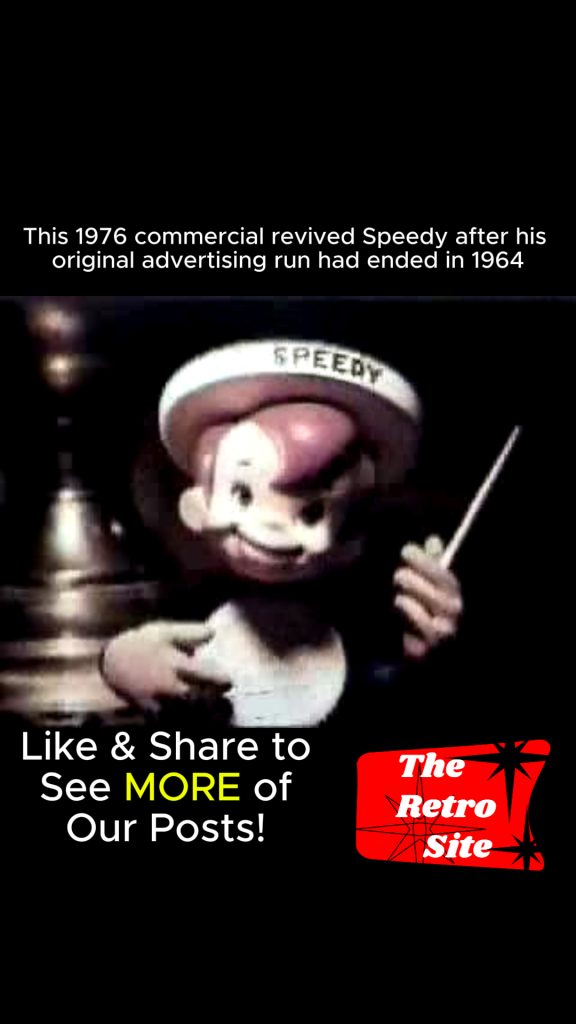
How many of you remember Speedy Alka-Seltzer? By the time this 1976 commercial appeared, Speedy was actually making a comeback. He had been one of television advertising’s earliest memorable mascots during the 1950s and early ’60s before disappearing from regular Alka-Seltzer advertising in 1964.
Speedy was a pretty clever character when you look closely. His body was an Alka-Seltzer tablet, another tablet became his little sailor-style hat, and he was brought to life one frame at a time with stop-motion animation. He was originally going to be called Sparky, but the name was changed to Speedy to match the company’s “Speedy Relief” campaign.
And that wonderfully youthful voice belonged to Dick Beals, who was already an adult when he began playing Speedy. A glandular condition left Beals only about four-foot-six with a voice that never changed from childhood, and he turned that into an extraordinary career. He also originated the voice of Gumby and was the first Davey on Davey and Goliath. He eventually performed voices in more than 3,000 commercials.
This 1976 revival also brought Speedy together with the line most of us probably remember best — “Plop, plop, fizz, fizz, oh what a relief it is.” The jingle was composed by Tom Dawes, who had previously been a member of the 1960s group The Cyrkle. Two years later, even Sammy Davis Jr. recorded his own versions of it.
Speedy had already shared the screen with silent-film legend Buster Keaton back in the 1950s, and he would eventually make another comeback decades later. For such a little guy, he had quite a television career
Did you remember Speedy himself, or is it the “Plop, plop, fizz, fizz” jingle that immediately takes you back?