THE 64-COUNT CRAYOLA BOX — OUR CHILDHOOD’S ULTIMATE UPGRADE!

https://www.theretrosite.com/wp-content/uploads/2026/11/00crayola.mp4

That meme about kids today wanting the latest electronics is so true. Back when I was a kid, all I wanted was that big box of 64 Crayola crayons!

It took a lot of begging, but I do remember finally getting one. Mom knew I’d be quiet with those crayons!
‎
And remember that built-in sharpener on the back? That alone made the big box something special.
‎
I did some digging and discovered Crayola introduced the 64-count box in 1958. Before that, the company’s original box back in 1903 had only eight colors.
‎
I even found a 1962 newspaper advertisement selling the big 64-count box for 57 cents on sale, regularly $1. Adjusted for inflation, that’s about $6.35 on sale or $11.15 at regular price in 2026 dollars.
‎
And here is something I never knew. In 1990, Crayola retired eight of its old colors, including Maize, Raw Umber and Lemon Yellow.
‎
People were actually upset enough to protest! There was even a Raw Umber and Maize Preservation Society trying to save those childhood favorites.
‎
In 2025, Crayola brought back eight retired colors for a limited time. Apparently, some of us never outgrew our attachment to those little sticks of wax.
‎
Of course, eventually some crayons broke, the paper wrappers disappeared and the sharpener filled up with colorful wax shavings.
‎
But opening that big box and seeing all 64 colors lined up was something special.
‎
Forget the latest electronics. Give me a coloring book and that big box of Crayolas!
‎
Did you have the 64-count box, or were you stuck with the little box of eight?
‎
#Crayola #CrayolaCrayons #64Crayons #VintageCrayola #1960s #1960sNostalgia #ChildhoodMemories #VintageToys #RetroCommercials #VintageCommercials #ColoringBooks #BabyBoomerMemories #RetroToys #TheRetroSite

WATCH JOE NAMATH GET CREAMED!

https://www.theretrosite.com/wp-content/uploads/2026/10/0noxjoe.mp4

Only in the 1970s could a shaving cream commercial turn something as ordinary as shaving into entertainment!

And who better to star in it than Broadway Joe Namath?

By this time, Joe had already guaranteed a victory over the heavily favored Baltimore Colts in Super Bowl III and then delivered. He was one of the biggest personalities in football, and his fame extended well beyond the playing field.

Then Noxzema came along and made getting creamed part of the act!
‎
What really makes this commercial memorable is that catchy jingle. The music has a funky, almost theatrical sound, with a singer enthusiastically encouraging us to let Noxzema cream our faces so our razors wouldn’t.

I did some digging and found that an advertising-music retrospective identifies an uncredited studio singer behind the famous Namath jingle, although I couldn’t establish the singer’s name for this particular recording.
‎
And the advertising worked well enough that Noxzema continued running Joe Namath commercials for more than three years.

According to the advertising agency’s historical account, they received surprisingly few complaints about the suggestive humor.

Another interesting thing is how many commercials Joe made over the years. In 1974, he even appeared in an advertisement for Beautymist pantyhose, wearing a pair himself!

That’s how big Broadway Joe had become. He could sell shaving cream, pantyhose and just about anything else advertisers put in front of him.

And more than 50 years later, we’re still watching him get creamed.

Do you remember these Noxzema commercials?

#JoeNamath #BroadwayJoe #Noxzema #NewYorkJets #SuperBowlIII #1970sCommercials #VintageCommercials #RetroCommercials #AdvertisingJingles #ClassicAdvertising #1970sNostalgia #VintageTelevision #TheRetroSite

Would You Believe…Don Adams Could Sell Almost Anything?

https://www.theretrosite.com/wp-content/uploads/2026/10/0bull.mp4

I was too young to drink beer when I first remember these commercials, and Don Adams wasn’t going to convince my dad to give up his Rheingold or Falstaff! But those Skittle Bowl-type commercials? We did buy those games and enjoyed them in our home.
⠀
That’s what I remember most about Don Adams as a pitchman. The commercials felt like little comedy sketches, with that unmistakable voice and the same confidence that usually got Maxwell Smart into trouble.
⠀
This Schlitz Malt Liquor commercial is dated 1980. Don plays a captured secret agent, and his captor is Leon Askin—General Burkhalter from Hogan’s Heroes. Naturally, the rescue involves the Schlitz bull and a familiar “Would you believe…” punch line.
⠀
But Don’s advertising career went well beyond beer. Aurora used him to promote a whole family of Skittle games, including pool, tennis, baseball, and bingo. Sometimes he was a spy; sometimes the commercials played like little gangster movies. He even appeared on Skittle Pool boxes.
⠀
Here’s something I didn’t know: Don also directed commercials. His Skittle Pool spot reportedly earned him a Clio for commercial direction in 1971. He was helping create the laughs as well as delivering them.
⠀
He also appeared in Hertz commercials with Penny Marshall before Laverne & Shirley made her a household name, and later advertised Ideal’s Electronic Detective with Joey Forman. Advertisers certainly knew how to put that secret-agent reputation to work!
⠀
Don didn’t change Dad’s beer order, but those game commercials got results at our house. Did you have Skittle Bowl or any of the other Skittle games?
⠀
#DonAdams #GetSmart #SkittleBowl #VintageCommercials #TheRetroSite

DO THE FONZIE — WHEN HAPPY DAYS GAVE THE FONZ HIS OWN DANCE

https://www.theretrosite.com/wp-content/uploads/2026/10/00fonzie.mp4

I had forgotten that Happy Days actually gave Fonzie his own dance.
‎
This is from the 1979 episode “Stolen Melodies,” and the setup is pure Happy Days. Leather Tuscadero, played by real-life rocker Suzi Quatro, has written a song called “Moonlight Love.” After auditioning for the television show National Sok Hop, the song suddenly turns up credited to another group.
‎
Naturally, Fonzie isn’t going to let that slide.
‎
He shows up at the TV studio, confronts the people involved and eventually takes over the microphone himself. Instead of letting the other band introduce its new dance, Fonzie brings out Leather and announces a brand-new one:
‎
“Do the Fonzie.”
‎
And then the Fonz actually has to dance.
‎
The song was written especially for the show by Jim Dunne and performed by Suzi Quatro. The dancing was choreographed by Shirley Kirkes, so somebody really did have the job of figuring out exactly how Fonzie should dance without making the coolest guy on television look completely ridiculous.
‎
Quatro was already a successful rock singer and bass player when she joined Happy Days as Leather Tuscadero. She later recalled that she was touring Japan when the show called her back to audition for the role.
‎
By this point Fonzie had become such a pop-culture phenomenon that Happy Days could invent an entire dance around him and it somehow made perfect sense.
‎
And just about a year later, one of Henry Winkler’s famous Fonzie leather jackets went into the Smithsonian.
‎
Do you remember “Do the Fonzie” — and would you have tried this dance at a sock hop?

WHEN SATURDAY AFTERNOON SPORTS HAD EVERYTHING

https://www.theretrosite.com/wp-content/uploads/2026/09/00cbs-sports.mp4

Looking back at this 1977 CBS promo, I’m reminded how different Saturday afternoon sports TV used to be. One edition of CBS Sports Spectacular gave us world championship boxing, NHRA drag racing, professional arm wrestling and The World’s Strongest Men — all on the same show.

The hot rods are what caught my attention. The footage came from the 1977 NHRA World Finals, a historic season that saw Shirley Muldowney become the first woman to win an NHRA world championship.

The arm wrestling has a story too. Promoter Steve Simons had formed the World Professional Armwrestling Association in 1974, hoping to move the sport out of bars and present it as a legitimate competition. By 1977, it had made its way onto national television through CBS.

And the strongman competition was brand new. This was the first year of World’s Strongest Man, won by Bruce Wilhelm. One of the competitors was Lou Ferrigno, right around the time America was getting to know him as The Incredible Hulk.

Even the boxing featured WBC welterweight champion Carlos Palomino.

That’s what I miss about shows like CBS Sports Spectacular. You might tune in for the drag racing and end up discovering boxing, arm wrestling or strongman competition.

Do you remember spending Saturday afternoons watching shows like this?

FUNYUNS — THE SNACK THAT ALMOST WASN’T CALLED FUNYUNS

https://www.theretrosite.com/wp-content/uploads/2026/09/000fun.mp4

This commercial takes me right back to when a bag of Funyuns seemed like one of the strangest snacks in the chip aisle. They looked like little onion rings, tasted like onions and even had a name that sounded like somebody made it up on the spot. As it turns out, somebody pretty much did!

Funyuns were introduced by Frito-Lay in 1969, created by employee George Wade Bigner. But here’s something I never knew: Funyuns weren’t supposed to be called Funyuns. The original name was OnYums, but that name was already taken. Advertising copywriter Jim Albright came up with “Funyuns” instead, and more than half a century later we’re still calling them that.

And listen closely to the music in these early commercials. The tune came from “I Love Onions,” a wonderfully odd 1966 novelty song recorded by Susan Christie. The song actually made the Billboard Hot 100 before its melody was adapted to help sell Funyuns.

Another great connection: in 1971, a young Roger Enrico went to work marketing Funyuns. He eventually became CEO of PepsiCo and was one of the men behind Pepsi’s blockbuster Michael Jackson era. Not a bad career beginning for a guy working on onion-flavored rings!

And yes, Funyuns are still around today.

Who had a Farrah Doll?

https://www.theretrosite.com/wp-content/uploads/2026/05/0farrah.mp4

The Farrah doll was part of full-blown Farrah Fawcett mania in the late 1970s, when her feathered hair, red swimsuit poster, and Charlie’s Angels fame were everywhere.

Mego released a Farrah Fawcett doll in 1977, right when she was one of the biggest TV and poster stars in America. The doll was about 12 inches tall, fully poseable, and came with Farrah’s famous long blonde hair. Some versions had outfits like a red top, denim shorts, white boots, and even accessories like a skateboard. The Smithsonian has a Farrah Fawcett doll with skateboards in its collection, describing it as a blonde doll dressed in a red shirt, blue denim shorts, and knee-high white boots.

There was also a Farrah’s Glamour Center toy made in 1977, showing how much her look was being sold as part of the fantasy. It wasn’t just “here’s a celebrity doll.” It was “here’s the hair, the style, the smile, and the whole Farrah look.”

What’s funny now is that the doll didn’t always capture Farrah perfectly. Like a lot of celebrity dolls from that era, it was close enough for kids and collectors to know who it was supposed to be, but not exactly museum-quality likeness. Still, that almost makes it more charming. Back then, if you had the Farrah doll, the poster, and maybe the haircut, you were officially living in 1977.

Farrah’s actual red swimsuit and related items were later donated to the Smithsonian, along with a 1977 Farrah Fawcett doll, which tells you how much that image and merchandising became part of pop culture history

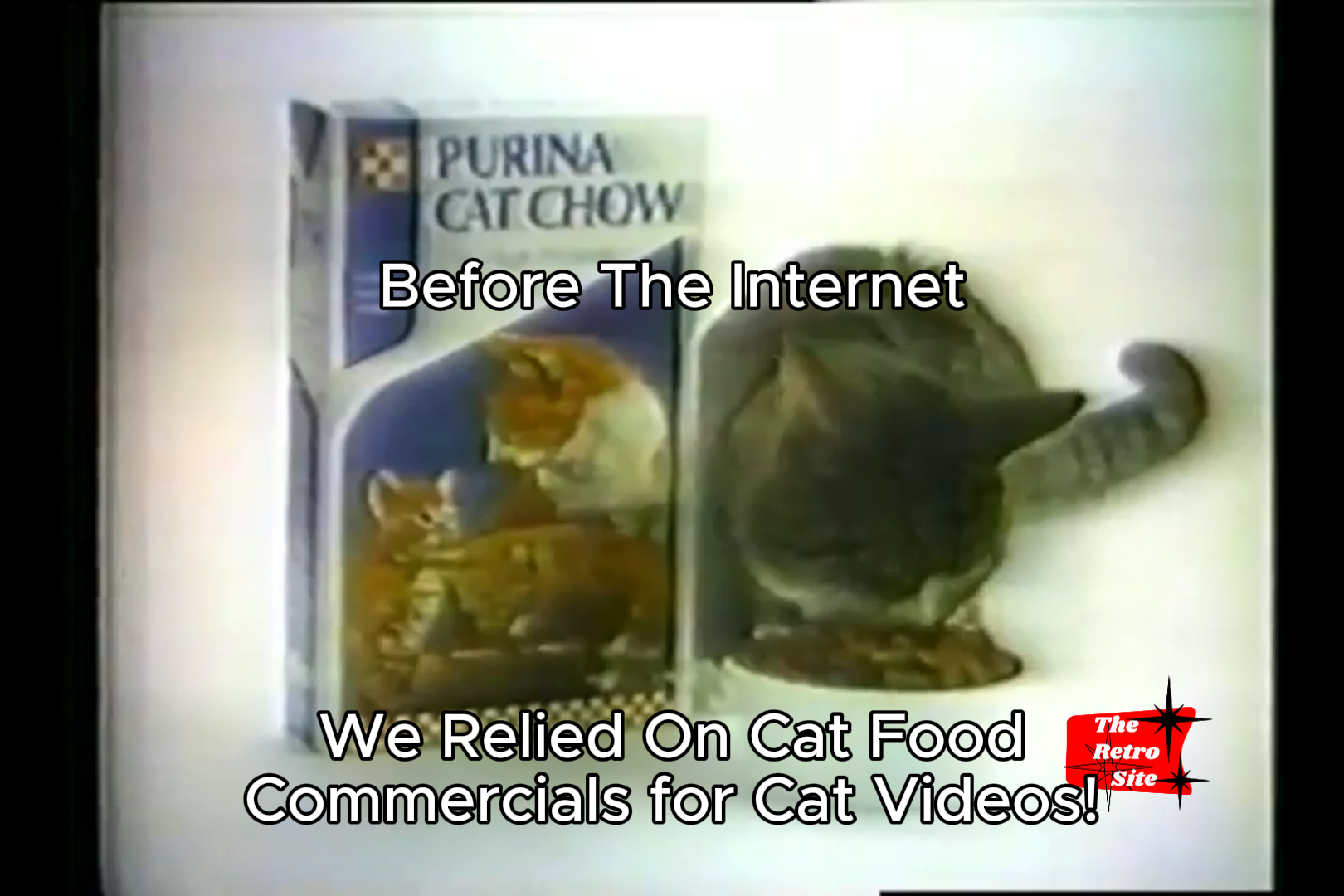
How We Got Cat Videos Before The Internet

https://www.theretrosite.com/wp-content/uploads/2026/05/0cat.mp4

Before the internet gave us endless cat videos, we had to take them wherever we could get them, and sometimes that meant a Purina Cat Chow commercial. This old ad feels almost like the Joe Weider offers in the back of comic books, where you were always being promised something special if you paid attention, mailed away, or bought the product.

Exit mobile version