online community focused on sharing and reminiscing about video, audio, and images that stir our memories of the past – old television, theme songs, commercials, print advertisements, the sights and sounds you remember
Before cereal commercials got too complicated, Cheerios gave us the Cheerios Kid, Sue, and the promise of “go-power.”
The idea was simple: eat Cheerios and suddenly you had the energy to take on whatever trouble showed up next. The late-1960s ads had that catchy “Get Yourself Go” jingle, the kind of line that stuck in your head long after Saturday morning cartoons were over.
A fun bit of trivia: the jingle is credited to Neil Diamond, before most of us knew him as the Neil Diamond.
Looking back, it was pure cereal-commercial magic: a bowl of oats, a quick cartoon adventure, and one more earworm we never quite forgot.
The Suzy Cute doll commercial is one of those 1960s toy ads that makes you stop and say, “Wait, is that really Louis Armstrong?”
Yes, it is.
The commercial was for Topper Toys’ Suzy Cute doll, part of the company’s Suzy line. After Armstrong’s huge 1964 hit “Hello, Dolly!”, Topper’s Henry Orenstein apparently thought, “Who better to sell a doll than the man singing about Dolly?” Armstrong filmed and recorded the spot on January 6, 1965, shortly after returning from a major overseas tour.
The ad has Armstrong singing and performing with a group of little girls while promoting the doll. What makes it so charming, and a little surreal, is that Armstrong does not phone it in. The Louis Armstrong House Museum notes that even the full unused take of the jingle shows him treating it seriously, scatting, encouraging the band, and even playing trumpet during the extended recording.
That is what makes the commercial so memorable today. It is not just a toy ad. It is one of the greatest jazz legends of all time giving full Louis Armstrong energy to a tiny baby doll commercial.
Only in the 1960s could a toy company say, “Let’s get Satchmo to sell Suzy Cute,” and somehow make it happen.
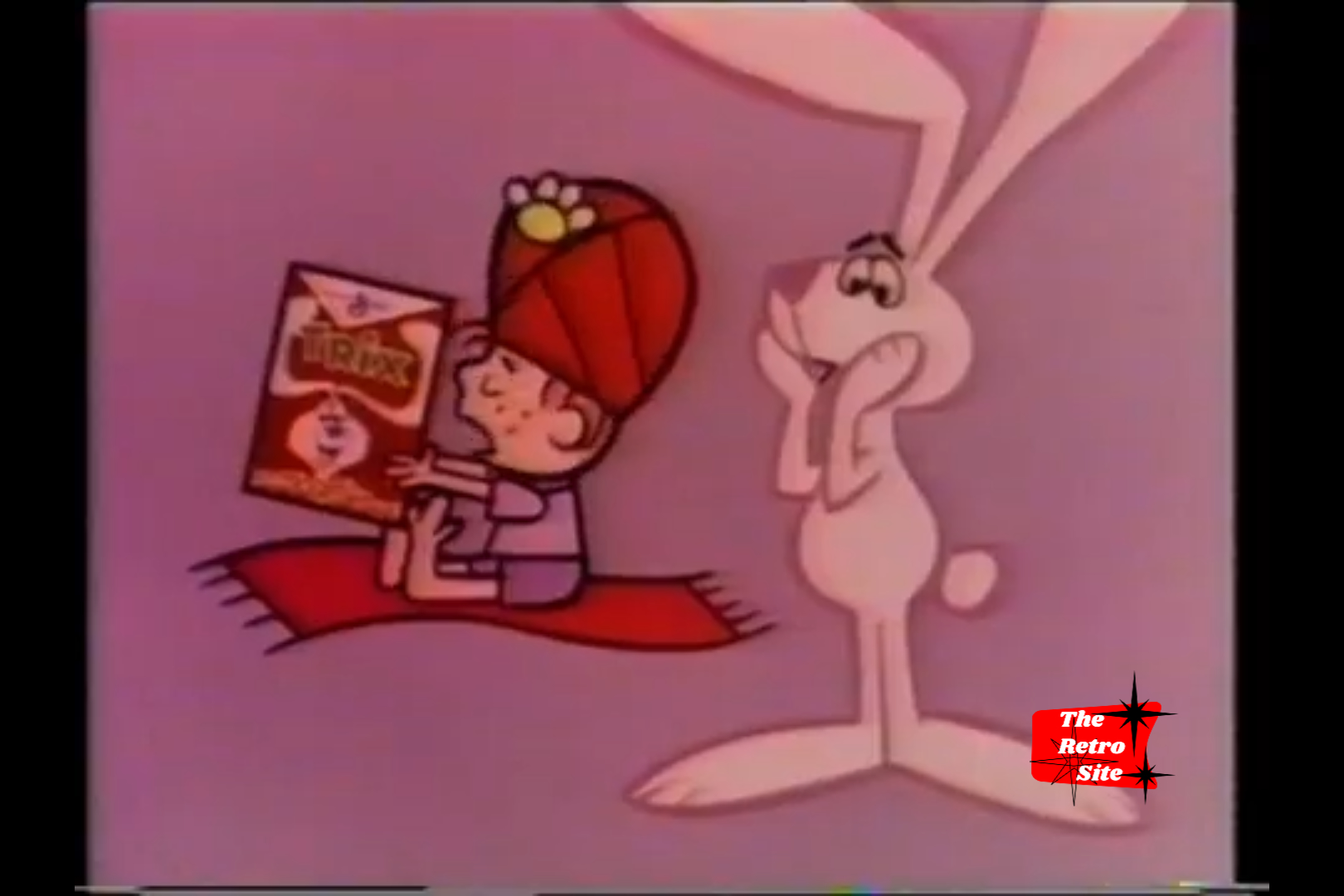
The Trix Rabbit is one of those cereal mascots who spent decades chasing the same bowl of cereal and almost never getting it.
Trix cereal was introduced by General Mills in 1954, but the famous slogan came a little later. General Mills says “Trix are for kids!” first appeared on the box in 1959, before the now-famous rabbit fully took over the campaign.
The setup was simple and perfect for kids: the rabbit wanted Trix, the kids caught him trying to get some, and then came the line everybody remembers:
“Silly rabbit, Trix are for kids!”
It worked because it was funny, colorful, and a little unfair. As kids, some of us probably felt bad for the rabbit. He tried costumes, schemes, disguises, and tricks, but those kids almost always shut him down.
Looking back, that was the magic of the campaign. One rabbit, one cereal, one catchphrase, and a generation that can still hear it in their head.
Today is National Donut Day, so it feels like the perfect time to celebrate with Fred the Baker and his famous line: “Time to make the donuts.”
Fred was played by actor Michael Vale, who became the face of Dunkin’ Donuts in commercials from the early 1980s until 1997. The whole idea was simple: while the rest of us were still sleeping, Fred was dragging himself out of bed before dawn to make fresh donuts. That tired little walk and mumble made him feel like every hardworking person who had to get up early and do the job.
National Donut Day itself goes back much further. It was created by The Salvation Army in Chicago in 1938 to honor the “Doughnut Lassies,” women who served donuts to soldiers during World War I. It also helped raise money for people in need during the Great Depression.
So today, grab a donut and give a little nod to Fred. He made getting up before dawn look exhausting, funny, and somehow heroic.
As a kid growing up, I didn’t understand why everyone said “Nobody doesn’t like Sara Lee” was incorrect English. I just knew they made great baked products.
The famous Sara Lee campaign was built around that odd but unforgettable line:
“Everybody doesn’t like something, but nobody doesn’t like Sara Lee.”
It was catchy, a little strange, and maybe not what your English teacher wanted to hear, but that was the point. The double negative made people notice it, remember it, and repeat it.
The commercials usually showed off Sara Lee cakes, pies, pound cake, coffee cake, and other desserts that looked like they came from a bakery, even if they came from the freezer. For a lot of families, Sara Lee was the “company’s coming” dessert you could serve without doing all the baking yourself.
Looking back, the grammar may have been questionable, but the advertising worked. Everybody had foods they didn’t like, but the campaign wanted us to believe Sara Lee was the one thing nobody could turn down.
And honestly, as a kid, I wasn’t diagramming the sentence. I was looking at the cake.
The Virginia Slims commercials were some of the most memorable cigarette ads of the late 1960s and 1970s, built around the famous slogan “You’ve come a long way, baby.”
The campaign launched in 1968, aimed directly at women during the era of women’s liberation. The ads usually compared an old-fashioned scene of women being told what they couldn’t do with a modern, confident woman enjoying her independence. Then came the message: women had come a long way, and Virginia Slims was supposedly the cigarette made for them.
Looking back, it was clever marketing, but also pretty calculated. The ads borrowed the language of women’s progress to sell cigarettes. They made smoking look stylish, modern, and independent at a time when cigarette advertising was still everywhere.
For those of us who remember the commercials, the slogan is the thing that stuck. “You’ve come a long way, baby” became bigger than the product itself. It was catchy, bold, and very much of its time.
Today, the campaign feels like a time capsule: part advertising genius, part cultural manipulation, and a reminder of when cigarette commercials could still shape pop culture before they were banned from television in 1971.
The Wendy’s Soviet Fashion Show ad was a wonderfully odd 1985 commercial from the same general era as Wendy’s famous “Where’s the Beef?” campaign.
The setup was simple: a fake Soviet fashion show where every outfit looked almost exactly the same: gray, shapeless, dull, and joyless. The announcer presents each look as if it’s glamorous high fashion: daywear, eveningwear, and the best-remembered punchline, “Swimwear.”
The joke was Cold War-era contrast. Wendy’s was saying other fast-food burgers were all the same, boring and uniform, while Wendy’s offered something better and different. It was a very 1980s ad idea: take a shot at Soviet sameness, then turn it into a hamburger comparison.
The spot was directed by Joe Sedelmaier, who was known for offbeat, deadpan commercials, including Wendy’s Where’s the Beef? work. IMDb lists the writers as Cliff Freeman and Joe Sedelmaier, with Lily Monkus among the credited performers.
It also drew some complaints at the time, though not as many as you might think. A 1985 Washington Post article reported Wendy’s received about 120 letters criticizing the Soviet-themed commercial, while the company noted that was small compared with its daily customer count.
Looking back, it’s pure 1980s advertising: Cold War humor, deadpan delivery, one unforgettable visual gag, and a punchline people still remember decades later:
Josephine from the Comet cleanser commercials was played by Jane Withers, who had already been famous years earlier as a 1930s child star. Later, a whole new generation knew her not from the movies, but as Josephine the Plumber.
Josephine appeared in Comet commercials from the 1960s into the 1970s, usually dressed in white work overalls and showing how Comet could handle stains, sinks, tubs, and other tough cleaning jobs.
What made the campaign stand out was that a woman plumber was highly unusual on TV at the time. That was part of the hook. Instead of using a typical male repairman, Comet gave viewers Josephine — friendly, confident, and no-nonsense. She knew the pipes, the porcelain, and exactly what cleaner to use.
The character worked because she felt practical and believable. She was not glamorous or fancy. She was the woman who knew how to get the job done. Jane Withers reportedly even took a plumbing course to make the role feel more authentic.
For a lot of viewers, Josephine was one of those commercial faces you trusted. If she said Comet cleaned better, you believed her. She had that perfect old-school ad quality: part neighbor, part expert, part TV personality, and completely unforgettable.
It was catchy, silly, and easy for kids to repeat, which is exactly what made old snack commercials work. A plain lunch suddenly felt more exciting when you added a bag of Fritos.
That was the charm of the campaign. It did not need a complicated story. It was just a happy little reminder that Fritos were salty, crunchy, and perfect next to a sandwich.
Before CGI, jump scares, and viral ads, Smokey Bear managed to give some of us a double take with one strange little public service announcement. Actress Joanna Cassidy calmly warned viewers about forest fires, then removed her red-haired “mask” to reveal she was actually Smokey Bear underneath.
It was supposed to remind us that everyone has a part to play in preventing forest fires. But if you saw it as a kid, you probably remembered the face-removal trick just as much as the message.