
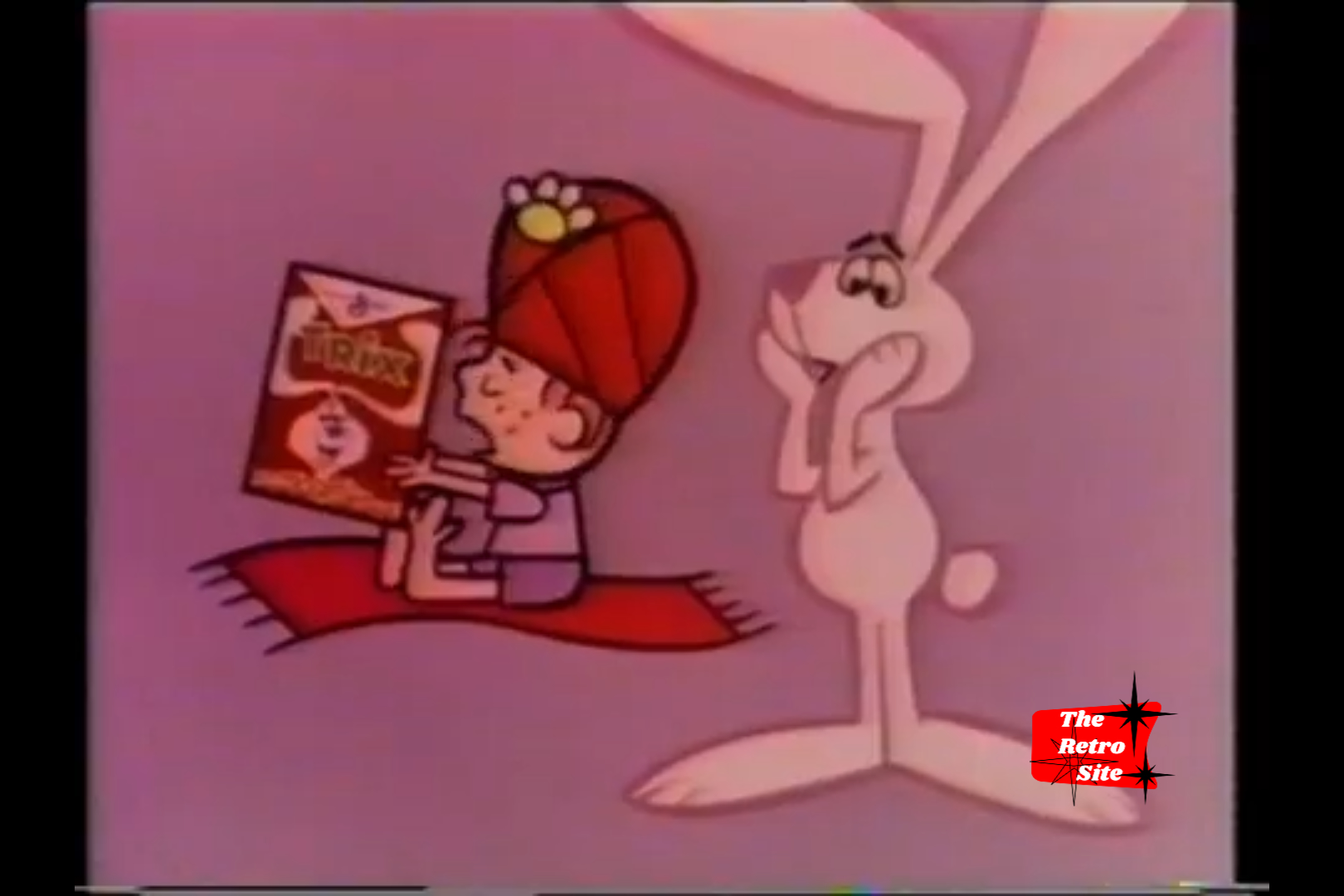
Silly Rabbit, Trix Are For Kids!

https://www.theretrosite.com/wp-content/uploads/2026/06/Trix.mp4

The Trix Rabbit is one of those cereal mascots who spent decades chasing the same bowl of cereal and almost never getting it.

Trix cereal was introduced by General Mills in 1954, but the famous slogan came a little later. General Mills says “Trix are for kids!” first appeared on the box in 1959, before the now-famous rabbit fully took over the campaign.

The setup was simple and perfect for kids: the rabbit wanted Trix, the kids caught him trying to get some, and then came the line everybody remembers:

“Silly rabbit, Trix are for kids!”

It worked because it was funny, colorful, and a little unfair. As kids, some of us probably felt bad for the rabbit. He tried costumes, schemes, disguises, and tricks, but those kids almost always shut him down.

Looking back, that was the magic of the campaign. One rabbit, one cereal, one catchphrase, and a generation that can still hear it in their head.

National Donut Day: Time To Make The Donuts With Fred

https://www.theretrosite.com/wp-content/uploads/2026/06/000000.mp4

Today is National Donut Day, so it feels like the perfect time to celebrate with Fred the Baker and his famous line: “Time to make the donuts.”

Fred was played by actor Michael Vale, who became the face of Dunkin’ Donuts in commercials from the early 1980s until 1997. The whole idea was simple: while the rest of us were still sleeping, Fred was dragging himself out of bed before dawn to make fresh donuts. That tired little walk and mumble made him feel like every hardworking person who had to get up early and do the job.

National Donut Day itself goes back much further. It was created by The Salvation Army in Chicago in 1938 to honor the “Doughnut Lassies,” women who served donuts to soldiers during World War I. It also helped raise money for people in need during the Great Depression.

So today, grab a donut and give a little nod to Fred. He made getting up before dawn look exhausting, funny, and somehow heroic.

Time to make the donuts!

Virginia Slims: “You’ve Come a Long Way, Baby”

https://www.theretrosite.com/wp-content/uploads/2026/06/Virginia-slims.mp4

The Virginia Slims commercials were some of the most memorable cigarette ads of the late 1960s and 1970s, built around the famous slogan “You’ve come a long way, baby.”

The campaign launched in 1968, aimed directly at women during the era of women’s liberation. The ads usually compared an old-fashioned scene of women being told what they couldn’t do with a modern, confident woman enjoying her independence. Then came the message: women had come a long way, and Virginia Slims was supposedly the cigarette made for them.

Looking back, it was clever marketing, but also pretty calculated. The ads borrowed the language of women’s progress to sell cigarettes. They made smoking look stylish, modern, and independent at a time when cigarette advertising was still everywhere.

For those of us who remember the commercials, the slogan is the thing that stuck. “You’ve come a long way, baby” became bigger than the product itself. It was catchy, bold, and very much of its time.

Today, the campaign feels like a time capsule: part advertising genius, part cultural manipulation, and a reminder of when cigarette commercials could still shape pop culture before they were banned from television in 1971.

Wendy’s Soviet Fashion Show: “Daywear… Eveningwear… Swimwear”

https://www.theretrosite.com/wp-content/uploads/2026/06/Wendys-Soviet-Fashion-Show.mp4

The Wendy’s Soviet Fashion Show ad was a wonderfully odd 1985 commercial from the same general era as Wendy’s famous “Where’s the Beef?” campaign.

The setup was simple: a fake Soviet fashion show where every outfit looked almost exactly the same: gray, shapeless, dull, and joyless. The announcer presents each look as if it’s glamorous high fashion: daywear, eveningwear, and the best-remembered punchline, “Swimwear.”

The joke was Cold War-era contrast. Wendy’s was saying other fast-food burgers were all the same, boring and uniform, while Wendy’s offered something better and different. It was a very 1980s ad idea: take a shot at Soviet sameness, then turn it into a hamburger comparison.

The spot was directed by Joe Sedelmaier, who was known for offbeat, deadpan commercials, including Wendy’s Where’s the Beef? work. IMDb lists the writers as Cliff Freeman and Joe Sedelmaier, with Lily Monkus among the credited performers.

It also drew some complaints at the time, though not as many as you might think. A 1985 Washington Post article reported Wendy’s received about 120 letters criticizing the Soviet-themed commercial, while the company noted that was small compared with its daily customer count.

Looking back, it’s pure 1980s advertising: Cold War humor, deadpan delivery, one unforgettable visual gag, and a punchline people still remember decades later:

“Swimwear.”

Sorry, Charlie!

https://www.theretrosite.com/wp-content/uploads/2026/05/Star-Kist.mp4

The StarKist “Sorry, Charlie” campaign started in 1961 and gave us one of the great advertising mascots: Charlie the Tuna. He was created by Tom Rogers of the Leo Burnett Agency as a beatnik-style tuna with a beret, thick glasses, and plenty of confidence. Charlie thought his “good taste” made him perfect for StarKist, but the joke was that StarKist did not want tuna with good taste — they wanted tuna that tastes good.

Charlie himself was originally voiced by actor Herschel Bernardi, who gave him that hip, New York, slightly theatrical sound. The famous announcer line “Sorry, Charlie” was voiced by Danny Dark, one of the biggest commercial voice-over artists of his era. StarKist’s own history page credits Dark as the narrator who delivered the line.

The commercials worked because Charlie was trying so hard to be chosen. He dressed sharp, talked cool, and acted like a sophisticated fish who deserved to end up in the can. Instead, he was rejected every time. Poor Charlie never understood that he was selling the product by not being good enough.

Looking back, it was a perfect old-school ad gag: one simple joke, a catchy phrase, and a character everyone remembered. “Sorry, Charlie” became bigger than tuna and turned into something people said whenever someone got rejected.

Exit mobile version