The Frito Bandito

https://www.theretrosite.com/wp-content/uploads/2026/06/Frito-Bandito.mp4

The Frito Bandito was introduced by Frito-Lay in 1967 as a cartoon mascot for Fritos corn chips. He was animated in early commercials by Tex Avery and voiced by Mel Blanc, the legendary voice behind Bugs Bunny, Daffy Duck, Porky Pig, and many others.

The idea was simple: the Bandito wanted your Fritos. With his sombrero, big mustache, pistols, and catchy jingle, he became one of those commercial characters kids remembered right away. The song, based on “Cielito Lindo,” made the ads especially hard to forget.

The campaign also drew complaints from Mexican-American groups who felt the character leaned too heavily on stereotypes. Frito-Lay softened his look over time, including removing the guns, but the character was eventually retired around 1971.

For many who grew up with late-’60s and early-’70s TV, the Frito Bandito is one of those ads that instantly brings back Saturday morning cartoons, snack commercials, and jingles you could still remember decades later.

Tags: Frito Bandito, Fritos, Frito-Lay, 1960s commercials, vintage advertising, retro commercials, Mel Blanc, Tex Avery, Saturday morning commercials, snack food ads, The Retro Site

When Guns Were Fun

https://www.theretrosite.com/wp-content/uploads/2026/06/guns.mp4

There was a time when a kid could watch a Saturday morning ad and immediately know what he wanted next: a Dick Tracy gun set.

Mattel’s Dick Tracy line included the Snub-Nose .38 pistol with a holster and the Tommy Burst Machine Gun, both tied into the famous comic-strip detective. The ad was pure early-1960s kid fantasy: a young boy playing detective, saving the day, and turning the living room into a crime-fighting headquarters while Dad tried to read the paper.

The Snub-Nose .38 was the kind of toy that made a kid feel like an undercover detective. Add the shoulder holster, and suddenly you weren’t just playing cops and robbers — you were Dick Tracy. The Tommy Burst took it even further, giving kids the look of an old gangster-era machine gun, except now the kid was the good guy chasing the crooks. Collectors still identify the Tommy Burst as part of Mattel’s early-1960s Dick Tracy toy line.

Watching those ads now, it is almost shocking how casually toy guns were sold to children. No disclaimers, no bright orange tips, no nervous wording. It was just “here’s the cool detective gear,” and every kid understood the assignment. Back then, toy guns were part of cowboy shows, police shows, war toys, spy kits, detective sets, and neighborhood games that lasted until the streetlights came on.

Of course, times changed. Today an ad like that would probably cause a committee meeting before it ever made it to TV. But for kids of that era, the Dick Tracy Snub-Nose and Tommy Burst weren’t about violence. They were about imagination, sound effects, hiding behind the sofa, and yelling “I got ’em!” before your mother told you to take it outside.

Did you have one of these Dick Tracy guns — or was this the kind of toy you circled in the catalog and never got?

Did you have Shark Pack?

https://www.theretrosite.com/wp-content/uploads/2026/06/Shark-Pack.mp4

I felt that changing the discs to make it do different maneuvers meant you might as well have pushed it by hand. Was I wrong?

Shark Pack was a 1970s toy boat line from Ideal, and the big feature was its interchangeable program discs. Instead of radio control, you put in a disc, set the boat loose, and it would follow a preset pattern, turning or circling depending on which disc you used.

For the time, that was a pretty clever idea. It gave kids a way to “program” the boat before home computers and remote-control toys became common. The commercial made it look exciting, with the boats cutting through the water and changing direction on command.

Like a lot of toys from that era, the real fun probably depended on where you used it and what you expected from it. If you had a pool, pond, or enough room to let it run, Shark Pack may have been a lot of fun. If you were expecting total control, the disc-changing part may have felt a little less magical.

That’s why I’m curious. Did Shark Pack really live up to the ad, or was it one of those toys that looked better on TV?

Who had a Secret Sam?

https://www.theretrosite.com/wp-content/uploads/2026/06/secret-sam.mp4

With all it could do, there were still many other toys I wanted more. I remember seeing the commercials and thinking it looked impressive, but I wasn’t sure it would live up to the way it looked on TV.

Secret Sam was a Topper Toys spy set from the mid-1960s, right when James Bond, The Man from U.N.C.L.E., and secret-agent gadgets were everywhere. The big item was the Secret Sam Attaché Case, a black briefcase that hid a toy gun setup inside. It could be used as a pistol, converted into a rifle, fitted with a silencer, and even fired from inside the case. Some versions also had a message missile and a small working camera.

So did it live up to expectations? Probably yes if you were deep into spy play and had a good imagination. But if you expected it to work exactly like a TV spy gadget, maybe not. Like a lot of toys from that era, the commercial did most of the heavy lifting.

Looking back, Secret Sam was the kind of toy that looked incredible under the Christmas tree, but the real fun depended on how much secret-agent adventure you could create around it.

Cheerios: Get Yourself Go!

https://www.theretrosite.com/wp-content/uploads/2026/06/Cheerios.mp4

Before cereal commercials got too complicated, Cheerios gave us the Cheerios Kid, Sue, and the promise of “go-power.”

The idea was simple: eat Cheerios and suddenly you had the energy to take on whatever trouble showed up next. The late-1960s ads had that catchy “Get Yourself Go” jingle, the kind of line that stuck in your head long after Saturday morning cartoons were over.

A fun bit of trivia: the jingle is credited to Neil Diamond, before most of us knew him as the Neil Diamond.

Looking back, it was pure cereal-commercial magic: a bowl of oats, a quick cartoon adventure, and one more earworm we never quite forgot.

Suzy Cute and Louis Armstrong: Yes, This Really Happened

https://www.theretrosite.com/wp-content/uploads/2026/06/suzy-cute.mp4

The Suzy Cute doll commercial is one of those 1960s toy ads that makes you stop and say, “Wait, is that really Louis Armstrong?”

Yes, it is.

The commercial was for Topper Toys’ Suzy Cute doll, part of the company’s Suzy line. After Armstrong’s huge 1964 hit “Hello, Dolly!”, Topper’s Henry Orenstein apparently thought, “Who better to sell a doll than the man singing about Dolly?” Armstrong filmed and recorded the spot on January 6, 1965, shortly after returning from a major overseas tour.

The ad has Armstrong singing and performing with a group of little girls while promoting the doll. What makes it so charming, and a little surreal, is that Armstrong does not phone it in. The Louis Armstrong House Museum notes that even the full unused take of the jingle shows him treating it seriously, scatting, encouraging the band, and even playing trumpet during the extended recording.

That is what makes the commercial so memorable today. It is not just a toy ad. It is one of the greatest jazz legends of all time giving full Louis Armstrong energy to a tiny baby doll commercial.

Only in the 1960s could a toy company say, “Let’s get Satchmo to sell Suzy Cute,” and somehow make it happen.

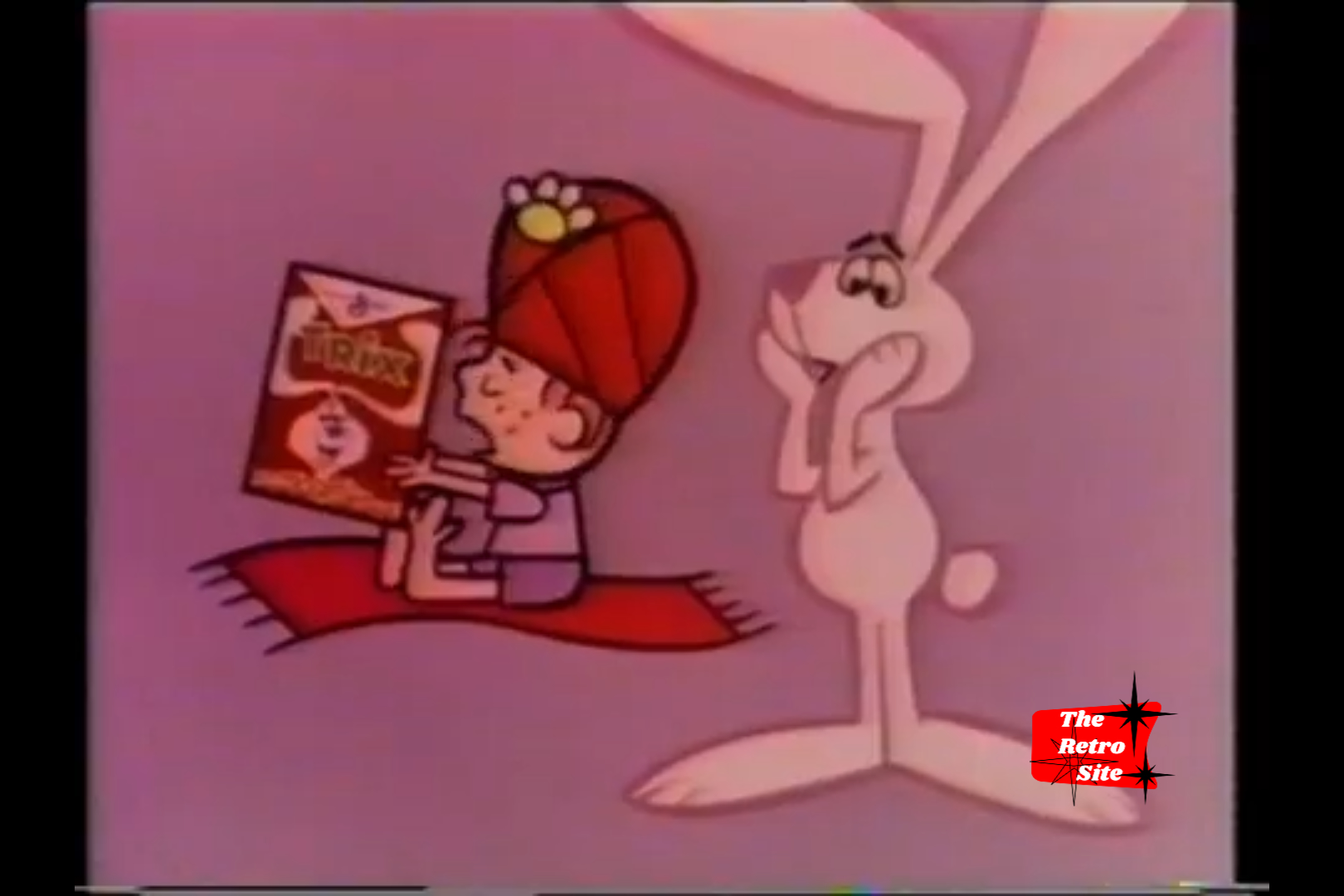
Silly Rabbit, Trix Are For Kids!

https://www.theretrosite.com/wp-content/uploads/2026/06/Trix.mp4

The Trix Rabbit is one of those cereal mascots who spent decades chasing the same bowl of cereal and almost never getting it.

Trix cereal was introduced by General Mills in 1954, but the famous slogan came a little later. General Mills says “Trix are for kids!” first appeared on the box in 1959, before the now-famous rabbit fully took over the campaign.

The setup was simple and perfect for kids: the rabbit wanted Trix, the kids caught him trying to get some, and then came the line everybody remembers:

“Silly rabbit, Trix are for kids!”

It worked because it was funny, colorful, and a little unfair. As kids, some of us probably felt bad for the rabbit. He tried costumes, schemes, disguises, and tricks, but those kids almost always shut him down.

Looking back, that was the magic of the campaign. One rabbit, one cereal, one catchphrase, and a generation that can still hear it in their head.

Whenever I saw the Barbie Cut ’n Curl commercial as a kid, I always wondered if it really worked as smoothly as it looked on TV.

https://www.theretrosite.com/wp-content/uploads/2026/06/Barbie-CnC.mp4

The idea was great: give Barbie a haircut, style her hair, curl it, and somehow keep the fun going without ruining the doll forever. Of course, commercials always made these toys look effortless. At home, I’m guessing it depended on patience, steady hands, and whether Barbie’s hair ended up looking salon-ready or like she had just lost a fight with a brush.

But here’s what I really want to know: Did you have Barbie Cut ’n Curl? Did it actually work the way the commercial showed?

And even better, did any of you start by cutting and styling Barbie’s hair and later end up becoming a hair stylist, barber, or working in cosmetology? Sometimes those childhood toys really did point us toward what we’d do later in life.

The Swing Wing: The Toy That Looked Like a Neck Injury Waiting to Happen

https://www.theretrosite.com/wp-content/uploads/2026/06/Swing-Wing.mp4

The Swing Wing was a wonderfully weird 1960s toy introduced by Transogram Games in 1965. It was worn on your head like a little cap, with a long ribbon or tail attached. The idea was to whip your head and neck back and forth until the tail spun around like a helicopter. Think Hula Hoop, but for your head.

The commercials made it look like pure kid fun: boys and girls swinging, twisting, dancing, and making the Swing Wing fly around them. But watching it now, you can almost hear every chiropractor in America screaming.

It was supposed to be Transogram’s answer to the Hula Hoop craze, with company hopes that it might become the next big toy sensation. It didn’t.

That’s probably why people remember it now more as a “what were they thinking?” toy than a classic. It had the perfect 1960s formula: bright colors, a catchy commercial, kids moving around like crazy, and absolutely no adult in the room asking, “Should children be violently snapping their necks for fun?”

Looking back, the Swing Wing is peak retro toy madness. Simple idea, great commercial, questionable safety, and the kind of thing that makes you wonder how any of us made it out of childhood with our heads still attached

“Muncha buncha, muncha buncha, Fritos go with lunch!”

https://www.theretrosite.com/wp-content/uploads/2026/05/0Fritos.mp4

It was catchy, silly, and easy for kids to repeat, which is exactly what made old snack commercials work. A plain lunch suddenly felt more exciting when you added a bag of Fritos.

That was the charm of the campaign. It did not need a complicated story. It was just a happy little reminder that Fritos were salty, crunchy, and perfect next to a sandwich.

You’re singing it now, aren’t cha?

Exit mobile version