“Brylcreem, a little dab’ll do ya…”

https://www.theretrosite.com/wp-content/uploads/2026/05/05072.mp4

That line was everywhere. The ads promised you didn’t need much, just a small dab, and suddenly you’d look sharp, smooth, and “debonair.” The jingle was credited to Hanley M. Norins of the Young & Rubicam advertising agency.

Of course, the best part was the promise that “the gals’ll all pursue ya” and love running their fingers through your hair. That was peak old-school advertising: use the product, look handsome, and suddenly romance is chasing you down the street.

By the 1960s, the Beatles and the dry, natural hair look started making heavily slicked hair seem old-fashioned, so Brylcreem had to adjust its pitch. But for anyone who grew up hearing that jingle, “a little dab’ll do ya” is still one of those lines that instantly brings back a whole era of bathroom mirrors, combs, crew cuts, and Dad’s medicine cabinet.

You Can Trust Your Car…can you finish it?

https://www.theretrosite.com/wp-content/uploads/2026/05/0texaco.mp4

You Can Trust Your Car to the Man Who Wears the Star was one of those great old advertising lines that stuck in your head because it did exactly what a slogan was supposed to do: it made the brand feel safe, familiar, and dependable.

Texaco’s “star” was right there in the logo, and the “man who wears the star” was the service station attendant. Back then, gas stations were not just places where you pumped your own gas and left. An attendant might check your oil, clean your windshield, look at your tires, and give the car a quick once-over while you sat behind the wheel. The campaign sold Texaco as more than gasoline. It sold trust.

The slogan became closely tied to Texaco’s image during the full-service gas station era. The message was simple: pull into Texaco, look for the star, and you were in good hands. It fit perfectly with the time, when uniformed attendants and branded service stations were part of the American road trip experience.

The jingle is most commonly credited to Roy Eaton, a pioneering Black advertising composer who worked on major campaigns including Texaco and Chef Boyardee Beefaroni. One profile says Eaton created the Texaco jingle in 1962, and another notes it was recognized by Advertising Age as part of one of the top ad campaigns of the 20th century. As for who sang the original version, that part is less clear. The safest answer is that it was likely performed by commercial session singers over the years, with different versions used in different Texaco spots.

The line worked because it sounded almost like a jingle before you even heard the music. “You can trust your car to the man who wears the star” has that smooth, sing-song rhythm that made it easy to remember. Texaco also used another famous star-themed line, “Star of the American Road,” leaning heavily into the red star logo as a symbol of dependability.

Looking back, it is a reminder of when gas stations felt more personal. The “man who wears the star” was not just selling gas. He represented service, pride, and that old-school promise that somebody actually knew your car and cared whether you made it down the road.

Jeff’s Collie

https://www.theretrosite.com/wp-content/uploads/2026/05/0jeffx.mp4

After posting about Lassie, many of you asked about Jeff’s Collie, which I was totally unfamiliar with, so please share your memories about this one! I don’t know if it wasn’t shown in our area or if somehow this got by me.

When Lassie first came to television in 1954, the boy was not Timmy. It was Jeff Miller, played by Tommy Rettig. Jeff lived on a farm with his widowed mother, Ellen Miller, played by Jan Clayton, and his grandfather, George “Gramps” Miller, played by George Cleveland. Those early years are often called Jeff’s Collie, especially in reruns and DVD releases.

That version ran from 1954 to 1957, covering the first several seasons of the show. The setup was still the same basic formula we all remember: a boy, a farm, a loyal collie, and some kind of trouble that Lassie had to fix before the episode ended. Jeff would get into scrapes, someone would need help, and Lassie would bark, run, and somehow explain the whole emergency better than most adults could.

The show changed after actor George Cleveland, who played Gramps, died in 1957. His death was written into the series, and the Miller family eventually left the farm. That opened the door for Timmy Martin, played by Jon Provost, to become Lassie’s new boy. From there, the show became the more famous Timmy and Lassie era.

So Jeff’s Collie is basically the “before Timmy” Lassie. Same famous dog, same wholesome adventure style, but with Tommy Rettig as Jeff instead of Jon Provost as Timmy. For people who watched the reruns, it could be confusing because one day Lassie belonged to Jeff, and another day she belonged to Timmy, and as kids we probably just accepted that Lassie had more family changes than most soap operas.

Summary:
Before Timmy became Lassie’s best-known TV companion, there was Jeff Miller in the early years of the series, often remembered as Jeff’s Collie. It was the original boy-and-his-dog era of Lassie, and somehow this one got by me, so I’d love to hear who remembers watching it.

Perry Mason’s theme reminds me of bedtime!

https://www.theretrosite.com/wp-content/uploads/2026/05/0perry.mp4

I’d hear that song from upstairs, and I’d sneak halfway down the stairs just to peek at Mom’s show. I remember asking why he was sitting there all alone in that big room, because I didn’t understand what a courtroom was or why everyone looked so serious. Mom still tried to explain it to me, even though I’m sure I was bugging her. All she wanted to do was relax and watch a little TV before her own bedtime.

As a kid, I could not understand why Mom watched such a boring show. There were no monsters, no cartoons, no spaceships, and nobody was falling down a well for Lassie to rescue. Just Raymond Burr sitting there as Perry Mason, calmly figuring out who really did it while everyone else in the courtroom waited for him to prove it.

The show originally ran on CBS from 1957 to 1966, with Raymond Burr as defense attorney Perry Mason, Barbara Hale as his secretary Della Street, William Hopper as private detective Paul Drake, and William Talman as district attorney Hamilton Burger. The famous theme was called “Park Avenue Beat” and was written by Fred Steiner. That opening music had a cool, jazzy, serious sound that basically told every kid in the house, “Fun time is over. The adults have taken over the TV.”

The funny part is, despite the show being around forever and becoming one of the most famous courtroom dramas in television history, I don’t think I’ve ever sat down and watched a single full episode. But I still remember that theme like it was yesterday. That was the sound of Mom’s TV time, the sound of being told to go back upstairs, and the sound of knowing bedtime was coming whether I liked it or not.

Lassie

https://www.theretrosite.com/wp-content/uploads/2026/05/0-lassie.mp4

Just hearing the opening whistle brings back a flood of childhood memories of Lassie.
As a kid, I vowed that one day I would get a collie and name her Lassie. Yeah, that never happened. I also didn’t get a dolphin and name it Flipper. But back then, Lassie made it seem like every problem could be solved with loyalty, courage, and a very smart dog who somehow always knew exactly where to go for help.
By 1959, Lassie was deep into the Timmy Martin years, with Jon Provost playing Timmy, June Lockhart as his mother, Ruth Martin, and Hugh Reilly as his father, Paul Martin. June Lockhart would later become another famous TV mom as Maureen Robinson on Lost in Space, but to me, she would always be Lassie and Timmy’s mom.
No matter how serious the problem was, everything seemed to get wrapped up neatly within the 22 minutes of the show. Someone could be lost, trapped, injured, or in danger, and somehow Lassie would bark, run, lead the adults to the right place, and make everything okay again.
And yes, Timmy actually did fall down a well, even though the old joke makes it sound like it happened every week. It happened in the 1960 episode “The Well,” where Timmy ends up trapped and, of course, Lassie has to get help. That one moment became the running gag everyone remembers: “What’s that, Lassie? Timmy fell down the well?”
Having a rough childhood, I always wished I had Timmy’s family. There was something comforting about that show, even if life was not really like anything we saw on TV. The Martins seemed steady, kind, and safe, and Lassie was always there watching over everyone. For a kid, that kind of world was easy to want.
Well, at least I have my cat Chassie, and yes, calling her reminds me of Lassie.

Did Miss Nancy Ever Call Your Name?

https://www.theretrosite.com/wp-content/uploads/2026/05/00000000.mp4

Did she ever call your name? Oh, the simple joys of Romper Room. That Magic Mirror had every kid sitting at home waiting, hoping Miss Nancy would say their name before the show ended. And if she did, you felt like you had just made national television from the living room floor.

I told you my father was a Marine, so we grew up in Virginia or North Carolina so we watched Miss Nancy on WBAL. But I never realized back then that there wasn’t just one “Miss Nancy.” Romper Room was franchised and syndicated, meaning different cities often had their own local hostesses using the same basic format.

The original Romper Room began in Baltimore in the early 1950s and was created by Bert and Nancy Claster, with Nancy Claster becoming the first well-known “Miss Nancy.” It was aimed at preschool children and felt like a TV nursery school, with songs, games, stories, manners, and those famous lessons about being a “Do Bee” instead of a “Don’t Bee.”

And then came the part we all remember: “Romper, bomper, stomper boo…” Miss Nancy would look through the Magic Mirror and start naming children she supposedly saw watching at home. We knew she probably couldn’t really see us, but at that age you weren’t taking chances. You sat there quietly, behaved like a Do Bee, and waited for your name.

That is what made the show work. She treated the camera like another child in the room, so the kids watching at home felt included too. It was simple television: a teacher, a few children, a Jack-in-the-box, a magic mirror, and lessons about being polite.

No explosions, no superheroes, no fast cuts (ok, maybe a clown in the Jack-in-the-box). Just Miss Nancy asking if we had fun at play.

And yes, I still remember waiting for my name. Did she ever call yours?

Breakfast With Clowns

https://www.theretrosite.com/wp-content/uploads/2026/05/0clown.mp4

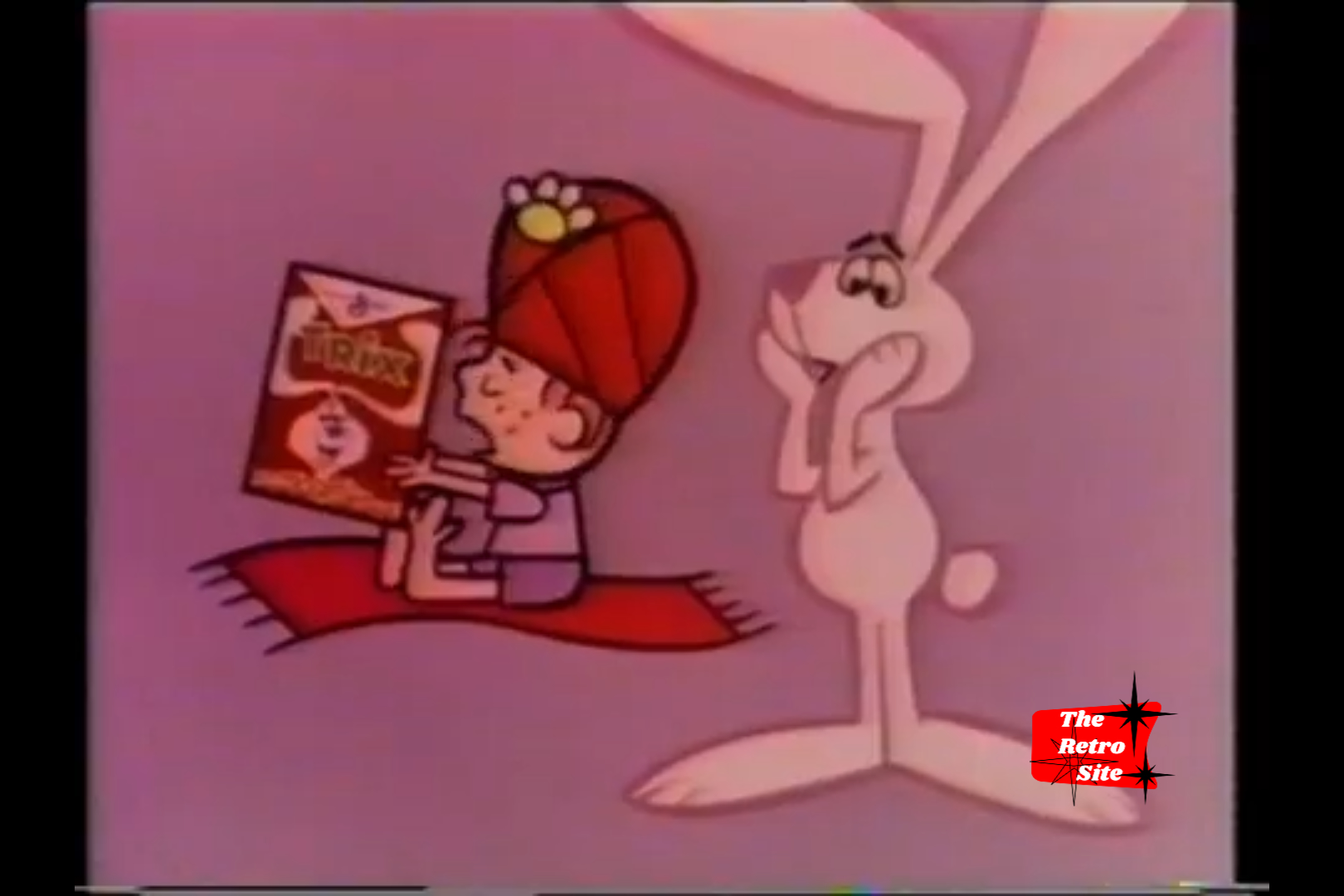
Back in our day, we had breakfast with clowns, and somehow nobody thought that was strange.

Post Sugar Rice Krinkles was one of those cereals that could only come from that golden age of Saturday morning television, when cereal companies put sugar right in the name and then sent a clown on TV to tell us it was part of a good breakfast. The cereal itself was a sweetened crisp rice cereal from Post, but the real memory-jogger was Krinkles the Clown, who showed up in those early commercials with that classic 1950s “fun for kids, slightly terrifying for adults” energy.

Looking back now, it is funny how normal that all seemed. We had clowns selling cereal, puppets selling chocolate, cartoon animals selling everything else, and we just sat there in our pajamas eating it all up before the cartoons came on. Sugar Rice Krinkles may be long gone, but it sits right in that strange and wonderful cereal aisle of our memories, back when breakfast was sweet, the commercials were catchy, and apparently clowns were welcome at the table.

N-E-S-T-L-E-S… Nestlé’s makes the very best…

https://www.theretrosite.com/wp-content/uploads/2026/04/00faf.mp4

I have vague memories of Farfel the dog himself, but that Nestlé’s jingle? That’s burned in there for life.

You know exactly what I’m talking about.

🎵 “N-E-S-T-L-E-S… Nestlé’s makes the very best…” 🎵
…and then that voice comes in to finish it…
“…chaaawwwwclit.”

Come on… you just heard it in your head, didn’t you?

That’s the part that stuck. Not the puppet, not even the commercial itself half the time… just that drawn-out delivery that somehow made it impossible to forget.

Now Farfel, for those who might not remember him as clearly, was this floppy-eared puppet dog created and voiced by Jimmy Nelson. He wasn’t flashy, wasn’t over-the-top… just kind of laid back, almost like he couldn’t be bothered to finish the word properly. And funny enough, that “lazy” delivery wasn’t even planned—it came from a mistake where the puppet’s mouth snapped shut early, and instead of fixing it, they kept it. Best decision they ever made.

And here’s something I was thinking about… back then, puppets didn’t creep us out the way they seem to today. You look at some of the comments online now and kids are like, “That thing is nightmare fuel!” Meanwhile, we were sitting there in the living room, probably on the floor, completely fine with it. No second thought. It was just part of the show.

Different time. Different mindset.

The commercial itself was simple. No crazy effects, no fast cuts, no overproduction. Just a catchy jingle, a memorable voice, and a brand like Nestlé making sure you never forgot their name. And it worked—because here we are, decades later, still singing it like it aired yesterday.

And that’s really the magic of those old commercials. They didn’t need to hit you over the head… they just slipped in, nice and easy, and stayed there.

Now I’ve got to ask… do you remember Farfel more, or is it the jingle that stuck with you like it did with me?

Proof! Ward Hit The Beaver!

https://www.theretrosite.com/wp-content/uploads/2026/03/Proof-Ward-Hit-The-Beaver.mp4

There’s a well-known scene from Leave It to Beaver where Ward Cleaver (Hugh Beaumont) is clearly frustrated with Beaver and starts to say something along the lines of disciplining him—what people later joke about as “hitting the Beaver.”

But what makes the moment memorable isn’t actual violence—it’s the awkward interruption and phrasing.

As Ward begins to sternly address Beaver, the situation shifts when others are present (or nearby), and the tone changes. Instead of following through with a harsh statement, Ward softens and redirects, choosing words more carefully. The writing leans into that classic 1950s TV dynamic: discipline is implied, but handled verbally and with restraint.

Over time, fans have latched onto these moments because of how they sound out of context. Lines like “Ward, don’t be too hard on the Beaver” became unintentionally funny decades later, especially when pulled away from the show’s wholesome tone.

The Reality

  • Ward never actually hits Beaver on the show
  • Discipline is almost always talk-based and lesson-driven
  • The humor comes from phrasing + timing, not action

Why it stuck in pop culture

The combination of innocent writing and changing language meanings turned these scenes into internet-era jokes. What was once a straightforward family moment now gets remembered for its accidental double meanings.

If you want, I can track down the exact episode that line gets closest to what you’re remembering—there are a couple of similar scenes fans mix together.

Safe in PF: The B.F. Goodrich Sneaker Campaign That Made History

In the late 1940s and into the 1950s, American playgrounds and ballfields were filled with kids sporting canvas sneakers that promised something more than style. Ads like the one proclaiming “Safe in PF Canvas Shoes by B.F. Goodrich” pushed a new kind of athletic footwear — PF Flyers — complete with a patented Posture Foundation insole and innovative suction-cup soles.

First introduced in 1937, PF Flyers were designed to give wearers “more speed, greater endurance, and better athletic performance.” By the postwar era, B.F. Goodrich had perfected its marketing, targeting children, teens, and parents with bold claims that sneakers could improve safety and sports performance. The campaign worked. PF Flyers quickly became one of America’s top-selling athletic shoes, rivaling Converse Chuck Taylors and cementing themselves as a cultural icon of mid-century sportswear.

The display pictured here, highlighting “The Tip-Off” sole with its suction-cup grip, is a classic example of B.F. Goodrich’s efforts to link science with play. It dates to around 1948–1955, a period when PF Flyers dominated basketball courts, baseball diamonds, and school gymnasiums across the country.

B.F. Goodrich, of course, no longer makes sneakers. In 1972, the company exited the footwear business to focus solely on tires, selling off the PF Flyers brand. Over the years, PF Flyers changed hands several times, even landing under New Balance in 2001. In 2021, entrepreneur Kassia Davis — founder of KADA — acquired the label, giving the heritage sneaker line new life.

Today, PF Flyers remain available as a standalone brand, with modern reissues of their vintage classics keeping the spirit of those mid-century ads alive. While the exact suction-cup sole model may not always be in production, the legend of “Safe in PF” continues to resonate with sneaker enthusiasts and nostalgia lovers alike.


Your purchase helps fund Retrosite.com to produce more memories for you through the Amazon Affiliate Program.

Exit mobile version