Remembering Combat! On Memorial Day

https://www.theretrosite.com/wp-content/uploads/2026/05/Combat-intro.mp4

Since this is Memorial Day, I thought the intro to Combat! was worth sharing.

This was another one of those shows a lot of our dads watched. To a kid, it looked like an action show: soldiers, rifles, tanks, explosions, and that serious opening that told you this was not going to be a cartoon-style adventure.

But Combat! was different from a lot of TV war shows. It followed an American infantry squad fighting through Europe during World War II, and it often focused less on glory and more on fear, loss, duty, and the bond between men trying to survive. The series aired on ABC from 1962 to 1967, starring Vic Morrow as Sgt. Saunders and Rick Jason as Lt. Hanley. It ran for five seasons and 152 episodes, making it one of television’s longest-running World War II dramas.

Looking back, I can understand why Dad watched it. Many in that generation either served, knew someone who served, or grew up in the shadow of World War II. For kids, we saw the uniforms and action. For them, there was probably a lot more behind it.

On Memorial Day, Combat! is a reminder that the Greatest Generation was not made up of movie heroes. They were young men asked to do impossible things, many of whom never came home.

The Rat Patrol

The Rat Patrol was another one of those shows Dad loved to watch, and to a kid, it sure looked promising. Jeeps tearing across the desert, guns mounted in the back, bombs going off, aircraft overhead — it had all the ingredients that should have grabbed a young viewer right away.

But at that age, the dialogue went right over my head. I was there for the action, not the strategy. The show followed a small Allied commando unit during World War II, racing through the North African desert and taking on German forces in fast-moving missions. It was part war show, part adventure series, and part Saturday afternoon action movie squeezed into a half-hour.

The Rat Patrol aired from 1966 to 1968 and starred Christopher George as Sgt. Sam Troy. One of the more interesting cast members was Hans Gudegast, who played German Capt. Dietrich. Soap fans would later know him much better as Eric Braeden from The Young and the Restless.

The show was loosely inspired by real desert raiding units like the British SAS and the Long Range Desert Group, but Hollywood gave it a very American spin. That bothered some viewers overseas because the real North African desert raids were largely a British and Commonwealth story, while the TV version put American characters front and center. The BBC reportedly pulled the show after only a few episodes because of complaints about that Americanized version of the war.

Looking back, I can see why Dad liked it. It had action, military drama, and just enough grit to feel grown-up. For us kids, it was the jeeps and explosions that pulled us in, even if we didn’t always understand what they were talking about once the shooting stopped.

Stop the Pigeon!

https://www.theretrosite.com/wp-content/uploads/2026/05/Dasterd-to-post.mp4

Dastardly and Muttley in Their Flying Machines was one of those cartoons built around one simple idea that somehow worked every time: stop the pigeon.

The show came from Hanna-Barbera in 1969 and brought back Dick Dastardly and Muttley from Wacky Races. This time, they were part of the Vulture Squadron, flying ridiculous contraptions and trying every week to catch Yankee Doodle Pigeon.

Of course, they never did.

The real star was Muttley. That wheezy little laugh was funnier than half the script, and his constant demand for medals made him even better. Dastardly would scheme, Muttley would snicker, the plane would fall apart, and the pigeon would fly away.

Looking back, most of us probably weren’t rooting for the pigeon. We were watching for Dastardly to lose his temper, Muttley to laugh, and that theme song to get stuck in our heads all over again.

Stop the pigeon, stop the pigeon!

Speed Racer: Our First Taste of Anime Before We Knew the Word

https://www.theretrosite.com/wp-content/uploads/2026/05/speedPost.mp4

Speed Racer was one of those cartoons that felt different the second it came on. The theme song hit, the Mach 5 took off, and suddenly we were watching cliffs, crashes, secret buttons, masked racers, gangsters, and more danger than most Saturday morning cartoons dared to show.

The show began in Japan as Mach GoGoGo in 1967 before becoming Speed Racer for American audiences. Most of us didn’t know we were watching anime back then. We just knew it didn’t feel like Bugs Bunny, Scooby-Doo, or the usual superhero cartoons.

Compared to American cartoons of the time, Speed Racer was faster, stranger, and more dramatic. There were revenge plots, family secrets, real danger, and Racer X lurking around like something out of a spy movie. The animation could be limited, but the style made up for it with speed lines, dramatic close-ups, wild crashes, and that nonstop rapid-fire dialogue.

And of course, there was the Mach 5. What kid didn’t want a car with buttons that could jump, saw through trees, go underwater, and somehow survive every impossible race?

Looking back, Speed Racer was a lot of kids’ first introduction to anime, even if we didn’t have that word yet. It was loud, weird, exciting, and unforgettable.

When Aftershave Came With Self-Defense Instructions

https://www.theretrosite.com/wp-content/uploads/2026/05/0hai.mp4

Hai Karate was one of those aftershaves that sold the joke as much as the scent.

It launched in 1967 and the whole idea was that the stuff made a man so irresistible that women would practically attack him. That is why the package and commercials leaned into the gag that every man needed self-defense instructions after putting it on. The famous warning was: “Be careful how you use it.”

The commercials were pure 1960s and early 1970s male fantasy advertising. A regular guy splashes on Hai Karate, and suddenly a woman goes wild for him. He has to use goofy karate moves to fend her off. It was played for broad slapstick laughs, with the martial arts craze and the “irresistible aftershave” idea mashed together into one very memorable campaign.

The campaign came from the ad firm McCaffrey & McCall, and one of the people behind the marketing plan was George Newall, who later became famous as a co-creator and songwriter for Schoolhouse Rock!

Looking back, it feels like the granddaddy of those later body spray ads where one spritz supposedly turns you into a babe magnet. Back then, though, Hai Karate had the extra gimmick: not only would women chase you, but you might need to defend yourself afterward.

It was silly, sexist, over-the-top, and very much of its time. But that is exactly why people remember it. The bottle may have been aftershave, but the real product was the joke.

What Would the Clampetts Be Selling Today?

https://www.theretrosite.com/wp-content/uploads/2026/05/winston.mp4

I remember watching this commercial as a kid, surprised that Jed smoked. I think we all knew Granny smoked, along with her moonshine.

What would Granny, Jed, Jethro, Ellie May, and Miss Jane be promoting today?

How We Got Cat Videos Before The Internet

https://www.theretrosite.com/wp-content/uploads/2026/05/0cat.mp4

Before the internet gave us endless cat videos, we had to take them wherever we could get them, and sometimes that meant a Purina Cat Chow commercial. This old ad feels almost like the Joe Weider offers in the back of comic books, where you were always being promised something special if you paid attention, mailed away, or bought the product.

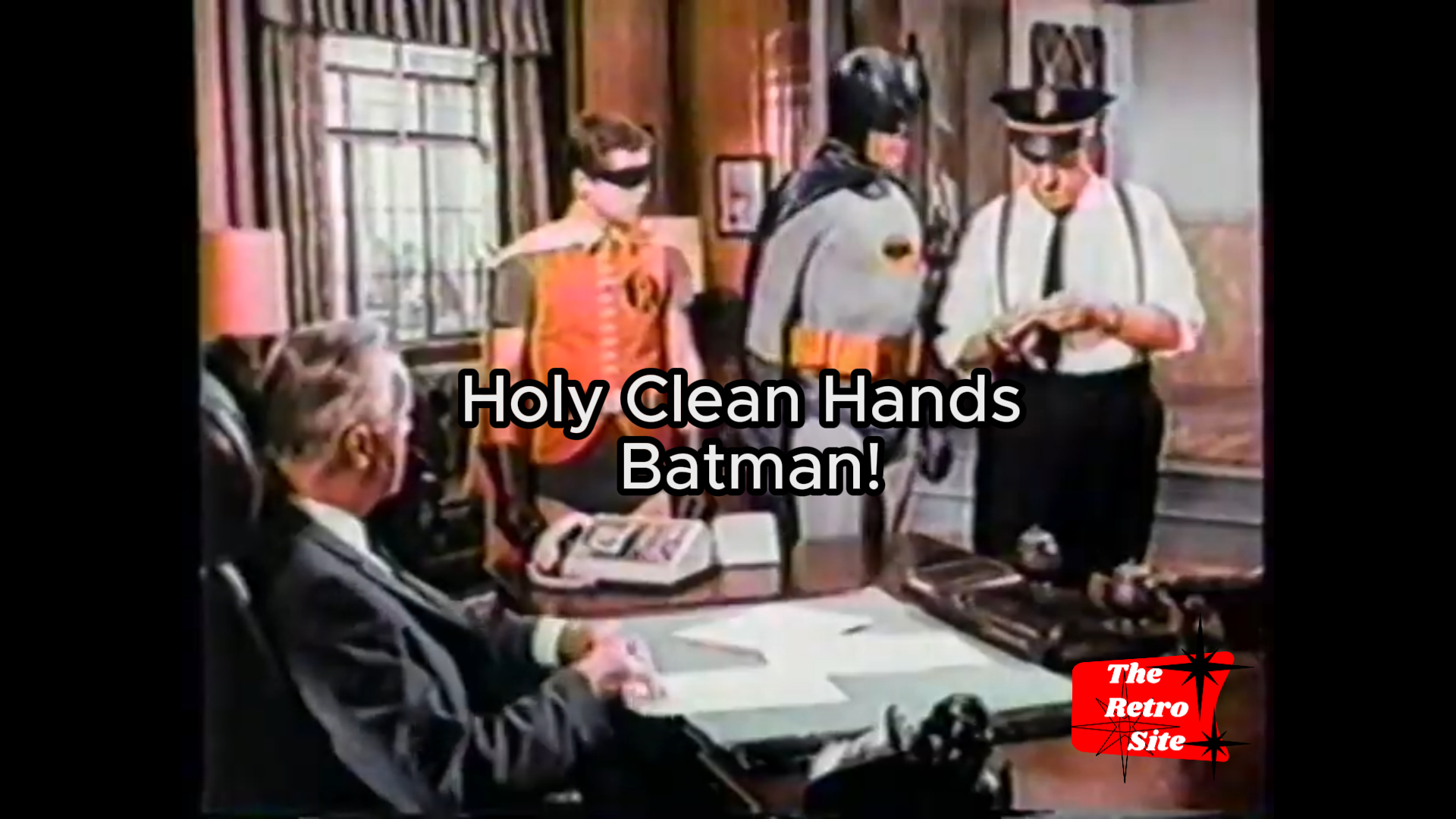
Holy Clean Hands, Batman!

https://www.theretrosite.com/wp-content/uploads/2026/05/00.mp4

I remember seeing this commercial as a kid and wondering what Lava Soap even was. I don’t remember if my mom ever actually bought it for us, but if Batman was selling it, I wanted it!

That was the power of 1960s Batmania. Adam West’s Batman was everywhere, including commercials for Lava Soap, the gritty hand soap meant for grease, grime, and dirty hands. It was the kind of soap dads kept near the garage sink, but to a kid watching Batman and Robin pitch it, it suddenly looked like something every crimefighter needed.

Did your family ever have Lava Soap in the house, or were you like me, just wanting it because Batman said so?

Hey Grandpa! What’s For Dinner?

https://www.theretrosite.com/wp-content/uploads/2026/05/00grandpa.mp4

It still wasn’t as bad as when Dad turned on Lawrence Welk, but Hee Haw always felt like the country cousin of Rowan & Martin’s Laugh-In. It had the same quick jokes, blackout skits, silly one-liners, and regular cast bits, just with more overalls, cornfields, banjos, and country music stars dropping by.

The show first aired in 1969, right around the same era when Laugh-In was still the cool, fast-moving comedy show everyone was talking about. Hee Haw took that same rapid-fire style and gave it a country spin, and somehow it stuck around for years. Even if you weren’t a big country music fan, you probably remember the corny jokes, the haystacks, the “salute” segments, and someone in the house laughing at lines that made the rest of us groan. And who can forget Grandpa?

The Pruitts Of Southampton

https://www.theretrosite.com/wp-content/uploads/2026/04/0000000-1.mp4

Oh, I can hear my mother singing along with Phyllis Diller on this one! Thanks to the viewer who requested this last week, it brought back a forgotten memory!

The Pruitts of Southampton was one of those 1960s sitcoms that had a wild setup and an even wilder star. It aired on ABC during the 1966-67 season and starred Phyllis Diller as Phyllis Pruitt, a supposedly rich Southampton widow trying to keep up appearances after the IRS discovers the family is actually broke. Instead of losing everything, she has to keep living like high society while secretly cutting corners and trying to hold the whole mansion together.

The show had a pretty impressive cast around her too, including Gypsy Rose Lee, Richard Deacon, Reginald Gardiner, and even Lisa Loring, who many of us remember as Wednesday from The Addams Family. Later in the season, the show was renamed The Phyllis Diller Show, but it still only lasted one season.

And yes, that catchy theme had a familiar name behind it: Vic Mizzy, the same composer who gave us The Addams Family theme. That probably explains why so many people remember the tune even if they barely remember the show itself. It was loud, silly, a little over-the-top, and totally Phyllis Diller. For a short-lived sitcom, it sure found a way to stick in people’s heads.

#ThePruittsOfSouthampton #PhyllisDiller #ClassicTV #RetroTV #1960sTV #TVNostalgia #TheRetroSite #BabyBoomerMemories #VintageTelevision #TVThemeSongs

Exit mobile version