Ho Ho Ho… Green Giant!

https://www.theretrosite.com/wp-content/uploads/2026/06/green-giant.mp4

Some commercials you don’t just remember — you can still hear them. The Jolly Green Giant made vegetables feel bigger than life with that booming “Ho Ho Ho!”

The Green Giant character first appeared in advertising in 1928, but he wasn’t always the friendly leafy giant we remember. In 1935, ad man Leo Burnett helped reshape him into the smiling Jolly Green Giant.

The TV version most of us remember really took off around 1961, when “Ho Ho Ho” became his signature line and “Good Things from the Garden” became part of the campaign. The deep voice belonged to Len Dresslar, a Chicago singer whose laugh became one of the most famous sounds in advertising.

The Giant later got a young helper, Little Green Sprout, in the early 1970s. The campaign faded in and out over the years, but it never really disappeared. Even if he wasn’t always in the commercials, he stayed right there on the package.

Ho Ho Ho… Green Giant!

Before Snoopy Was Shaving Ice, There Was Ice Bird

https://www.theretrosite.com/wp-content/uploads/2026/06/Ice-bird.mp4

Before the Snoopy Sno-Cone Machine became the one everyone remembers, Kenner had Ice Bird, a 1974 toy that promised kids they could make their own icy treats at home.

The idea was simple and very 1970s: put in the ice, shave it down, pack it into little balls, and pour on the flavored syrup. Suddenly, you weren’t just eating a frozen treat. You were running your own little snowball stand from the kitchen table.

The commercial made it look easy, clean, and exciting, which is exactly what a good toy commercial was supposed to do. But like a lot of food-making toys from that era, the big question is whether it worked as well in real life as it did on TV. Did the ice shave smoothly? Did the syrup go everywhere? Did you end up with a perfect treat, or just a sticky mess?

Still, Ice Bird had that great kid-powered appeal. It took something ordinary, ice from the freezer, and turned it into something that felt special. And for a kid watching Saturday morning cartoons, “make your own ice balls” sounded like a pretty big deal.

Did you have Ice Bird? And did it live up to the commercial?

When Even Toilet Paper Had Style

Today, designers tell us how to fluff a couch, karate chop a throw pillow, stack coffee table books, and make a room look “curated.”

But somehow, we lost designer toilet paper.

Back in the 60s and 70s, bathrooms had personality. Pink sinks, blue tubs, avocado tile, fuzzy toilet lid covers, and yes, toilet paper that matched. You could buy pastel rolls and even printed patterns to go with the bathroom decor.

Nobody needed a TV designer to explain it. Mom knew. Grandma knew. The toilet paper matched the room.

Then colored toilet paper faded away. Concerns over dyes, perfumes, septic systems, the environment, and cost helped make plain white the standard.

Now everything in the house can be designer, except the one thing that used to quietly tie the whole bathroom together.

Maybe the 70s had it right after all.

Speedline Race Cars: The Hot Wheels Rival

https://www.theretrosite.com/wp-content/uploads/2026/06/speedline.mp4

Many of you asked about these when I posted the Hot Wheels advertisement. So now I have to ask: which did you have? Hot Wheels, Matchbox, Speedline, or all of them?

Speedline race cars were part of that late-19660s toy-car boom, when every company wanted a piece of the racing action. Hot Wheels had the orange track and wild colors, Matchbox had the more realistic little cars, and Speedline tried to get into the race with its own fast-looking cars and track sets.

They never became as famous as Hot Wheels, but that’s what makes them fun to remember. Some kids had the big names. Some had the off-brand or lesser-known racers. And honestly, when you were on the floor setting up races, it didn’t always matter what brand was stamped underneath. If the car was fast, it made the lineup.

For a lot of us, these little cars were more than toys. They were races across the living room, arguments over whose car won, and the beginning of a car collection before we even knew we were collecting.

So which ones were in your house?

Here’s Lucy

https://www.theretrosite.com/wp-content/uploads/2026/06/0-heres-lucy.mp4

Here’s Lucy kept Lucille Ball on Monday night TV with the same kind of physical comedy, celebrity guest stars, and family-style chaos that made her a television legend. This time, Lucy Carter was a widow working for her brother-in-law Harry, played by Gale Gordon, while her real-life children Lucie Arnaz and Desi Arnaz Jr. played her kids.

The show had that familiar Lucy formula: a simple situation gets out of control, Lucy gets into trouble, Harry gets frustrated, and somehow the whole thing turns into comedy. It also became known for big guest stars, including classic Hollywood and TV names, which made each episode feel like a little variety-show surprise.

For fans, Here’s Lucy was not just another sitcom. It was Lucille Ball proving she could still carry a hit show after I Love Lucy and The Lucy Show, while bringing her own family into the act.

Cheerios: Get Yourself Go!

https://www.theretrosite.com/wp-content/uploads/2026/06/Cheerios.mp4

Before cereal commercials got too complicated, Cheerios gave us the Cheerios Kid, Sue, and the promise of “go-power.”

The idea was simple: eat Cheerios and suddenly you had the energy to take on whatever trouble showed up next. The late-1960s ads had that catchy “Get Yourself Go” jingle, the kind of line that stuck in your head long after Saturday morning cartoons were over.

A fun bit of trivia: the jingle is credited to Neil Diamond, before most of us knew him as the Neil Diamond.

Looking back, it was pure cereal-commercial magic: a bowl of oats, a quick cartoon adventure, and one more earworm we never quite forgot.

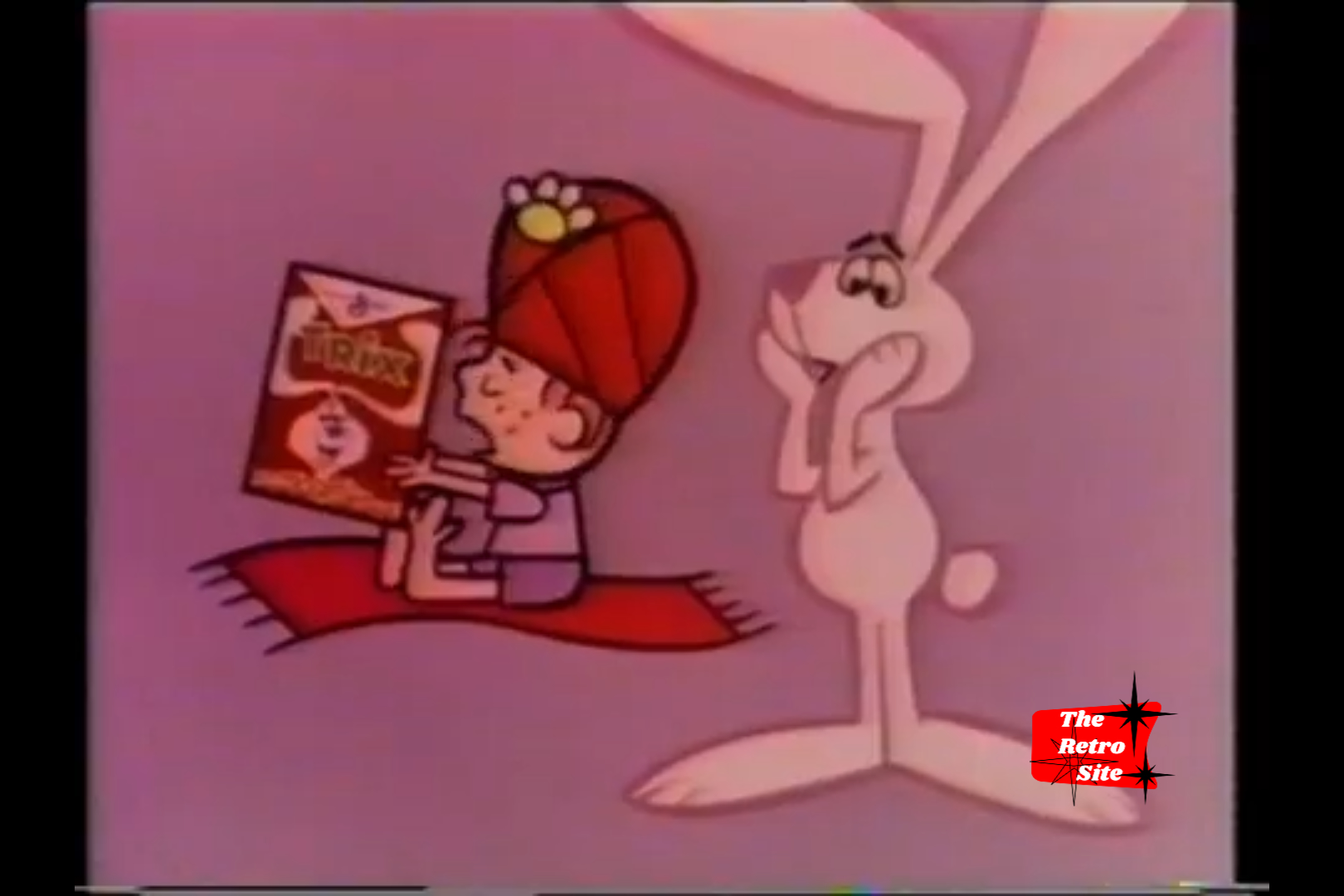
Silly Rabbit, Trix Are For Kids!

https://www.theretrosite.com/wp-content/uploads/2026/06/Trix.mp4

The Trix Rabbit is one of those cereal mascots who spent decades chasing the same bowl of cereal and almost never getting it.

Trix cereal was introduced by General Mills in 1954, but the famous slogan came a little later. General Mills says “Trix are for kids!” first appeared on the box in 1959, before the now-famous rabbit fully took over the campaign.

The setup was simple and perfect for kids: the rabbit wanted Trix, the kids caught him trying to get some, and then came the line everybody remembers:

“Silly rabbit, Trix are for kids!”

It worked because it was funny, colorful, and a little unfair. As kids, some of us probably felt bad for the rabbit. He tried costumes, schemes, disguises, and tricks, but those kids almost always shut him down.

Looking back, that was the magic of the campaign. One rabbit, one cereal, one catchphrase, and a generation that can still hear it in their head.

Two-Year-Old Tiger Woods On TV

https://www.theretrosite.com/wp-content/uploads/2026/06/2yo-tiger-woods.mp4

Before he became one of the greatest golfers of all time, Tiger Woods was a 2-year-old kid on The Mike Douglas Show, standing beside his father Earl and putting while Bob Hope watched.

The clip is incredible because it is not just cute. You can already see the swing, the confidence, and the beginning of something unusual. Tiger’s father, Earl Woods, had introduced him to golf almost as soon as he could walk, and he became his first coach, teacher, and biggest influence.

Earl did more than teach him how to hit a ball. He taught Tiger discipline, focus, and how to handle pressure. That early father-son bond helped shape the child prodigy who would grow into a golf legend.

Looking back, that little TV appearance feels like the first public glimpse of history. A toddler with a golf club, a proud father nearby, and the start of a career nobody could have fully imagined yet.

National Donut Day: Time To Make The Donuts With Fred

https://www.theretrosite.com/wp-content/uploads/2026/06/000000.mp4

Today is National Donut Day, so it feels like the perfect time to celebrate with Fred the Baker and his famous line: “Time to make the donuts.”

Fred was played by actor Michael Vale, who became the face of Dunkin’ Donuts in commercials from the early 1980s until 1997. The whole idea was simple: while the rest of us were still sleeping, Fred was dragging himself out of bed before dawn to make fresh donuts. That tired little walk and mumble made him feel like every hardworking person who had to get up early and do the job.

National Donut Day itself goes back much further. It was created by The Salvation Army in Chicago in 1938 to honor the “Doughnut Lassies,” women who served donuts to soldiers during World War I. It also helped raise money for people in need during the Great Depression.

So today, grab a donut and give a little nod to Fred. He made getting up before dawn look exhausting, funny, and somehow heroic.

Time to make the donuts!

Sesame Street’s Counting Songs: The Numbers That Got Stuck In Our Heads

https://www.theretrosite.com/wp-content/uploads/2026/06/sesame.mp4

When people mention the Sesame Street counting song, a lot of us instantly hear that funky:

“1, 2, 3, 4, 5…”

The best-remembered version is the Pinball Number Count, the animated segment where a pinball rolls through wild little number-themed machines while the song counts up to 12. It was recorded by The Pointer Sisters in 1976, which explains why it had so much more groove than a regular kids’ counting song.

That was part of Sesame Street’s genius. They didn’t talk down to kids. They used real music, catchy animation, and repetition that worked. You learned numbers without feeling like you were being taught.

There were plenty of other number songs on Sesame Street, including ones focused on counting to 10, but the Pinball Number Count is probably the one most people remember first. It was funky, fast, colorful, and impossible to forget.

For a lot of us, that little pinball didn’t just teach numbers. It gave us one of the greatest earworms in children’s TV history.

Exit mobile version